in conversation with
Nina Turok Shapiro
Nina Turok Shapiro's (b. 2000, South Africa) practice is rooted in an interest in memory and identity, her work draws from personal and familial archives, reimagining fragments of the past through carefully constructed images and layered surfaces through screenprinting.
As a second-generation South African within the Jewish diaspora, Shapiro’s practice reflects on the silences and gaps that often inhabit inherited histories. Through performative photographs and printmaking, she revisits family narratives; allowing colour, repetition and gesture to evoke the fragile textures of nostalgia.
Her work occupies a space between documentation and imagination; moments drawn from the archive are reconfigured through image and material, creating compositions that feel at once intimate and unresolved. In this way, Shapiro’s practice becomes a quiet inquiry into memory, emotional inheritance and the ways personal histories continue to echo across generations.
We met Shapiro in her studio, the soft cadence of screenprinting frames much of her daily practice. She spoke with us about the material language of printmaking and the process that continues to shape her work.

NZ: When you first started making work — before even getting into the questions — when was that, and how did it look compared to where it is now?
I’ve always been making art, but not in the way I do now. I only really started thinking about it more conceptually when I got to university. I was quite against the conceptual side at first, but then I started to see the value in it.
It was COVID in my first year, so everything became more conceptual because they couldn’t really teach us the technical side properly without being in person. We had projects like black and white self-portraits, and I just loved that. I got really into photographic work. My mom is a photographer, so I was lucky to have access to a backdrop and proper lighting, even though I was just using my phone. Being able to experiment like that at home allowed me to challenge myself creatively, which I think was really important.
At that time everything was black and white. I felt like I thought in black and white — that just made sense to me. Then I started doing printmaking in second year and was introduced to screen printing. I loved it immediately. And that’s when I started bringing in the family archive, as well as colour. Screen printing felt like the perfect way to merge my love of photography with printmaking, while thinking about my role within my [family] archive.
NZ: Your work features a lot of your family. When you return to your family archive, what is the first thing you feel; curiosity, nostalgia or something else entirely?
I think I feel both of those things. I feel like I lean a lot into nostalgia in my life. And also, as my family dynamics have gotten more complicated, I’ve gone deeper and deeper into that.
I also have some regressive tendencies — I am the baby in my family — so I think that’s where it comes from as well. It’s almost like trying to make it whole again, holding onto nostalgia, a feeling from that time.
MR: So in making work from this familial material, where do you place yourself? Are you inside the memory, outside of it, or somewhere in between? Because you’re going back to something you didn’t live, but also inserting yourself into it — where do you fit?
I think I feel a bit like a voyeur over it, which is nice. I do feel like I’m re-constructing something, so in that way I’m outside looking in. But when I was at Michaelis, I also made some prints using photos of myself — printing two different images over each other, some of them superimposed — so it felt like I was placing myself back into the archive.
That’s when I started thinking about creating a nonlinear archive. So I think I exist somewhere in between.
MR: How does the experience of being second-generation in the Jewish diaspora influence the way you think about presence, absence, and the archive you explore?
There is obviously a lot of discourse around the holocaust and those broader historical narratives. So for me, my work is a way of tapping into more personal histories and personal narratives — the specificity of my family. I also come from a much more left-wing family than a lot of the people I grew up around, so I feel like it’s important to bring that kind of personal narrative into the work. At the same time, I sometimes feel uncomfortable engaging with my family archive because it is Jewish. I think, “Who cares right now? Why does that voice need to be there?” But then I also feel like it is important, especially as someone who doesn’t necessarily represent the dominant or expected version of that identity.
I struggle with that a bit. Even when I tell people I’m Jewish, I say it, but I don’t fully connect with the larger Jewish community in South Africa. At the same time, there is still a sense of connection, it is a community, and it’s a strong one, here and globally. I do feel quite disconnected, but I think going into my family archive is a way of connecting to that identity in my own way, and on my own terms.
Namrata to Nina: Politically, with everything that’s going on, there’s a lot of inherent antisemitism that comes up; suddenly, there’s this sense of shame that can attach itself — even though you didn’t choose your identity and you’re not aligning yourself with anything that’s happening [with the genocide and in the Middle East]. That must be quite tricky to navigate — because you’re trying to connect the dots with your own lineage, which went through its own struggle.
There’s that kind of double consciousness, where you are wanting to tell your story and connect with your people, but also not wanting it to seem ignorant of what’s going on in the present.
Everything we’re shown — through media, through history — is often presented in binaries. But life doesn’t actually function like that. Your experience is valid in its own right, and you shouldn’t feel any shame in speaking from that place.
Nina to Namrata: I totally agree, a lot of those things do go through my head. I also feel very strongly that Judaism and Zionism are different things. I know that, and I acknowledge that, and I feel quite strong in my position. I just have to remind myself of it sometimes. And also remind myself that this is familial — this is my archive. This is just me trying to make sense of things.
MR: So your work sits between memory and invention. When you’re making a piece, how do you decide what to hold onto and what to let slip into abstraction?
I’m usually — if not always — drawn to the hands of people, and the points of contact between them. Also things that signify the time, like clothing. Those are the elements I tend to hold onto.
I don’t mind if the rest of the images become abstracted along the way. I also like to crop faces out of the frame — for a few reasons, but initially it was about making the work more approachable: allowing viewers to insert themselves into the image, into the archive or the memory, by attaching it to their own family members. What’s been really interesting is that people with completely different backgrounds connect to these images, and I really like that. Also, with screen printing, things naturally abstract themselves. I’m quite open to that because I don’t always trust my direct mark-making. I like that there are multiple processes within the process, which becomes part of the aesthetic decision-making.
MR: What does it mean for you to make peace without knowing — to sit with those gaps and hold them?
I think it feels like an exciting thing to leave open. Because that’s where people can insert themselves into the work. That’s when it becomes most interesting — in the “not knowing”, and in making something up for yourself. The tattoo I have is from a piece I made based on a photograph of my great-grandfather. There was this woman, looking very cosy next to him, they were all dressed up, it was quite a strange scene from the early 1930s. And no one knows who she is, or who a lot of the people in that image are.
I’m kind of obsessed with that. Like, what if she was someone he had an affair with, and this is the only photograph of them together? I like imagining those kinds of connections — filling in the gaps. I know there’s a lot I don’t know, and I’m interested in that. In the secrets, in what remains unknown.
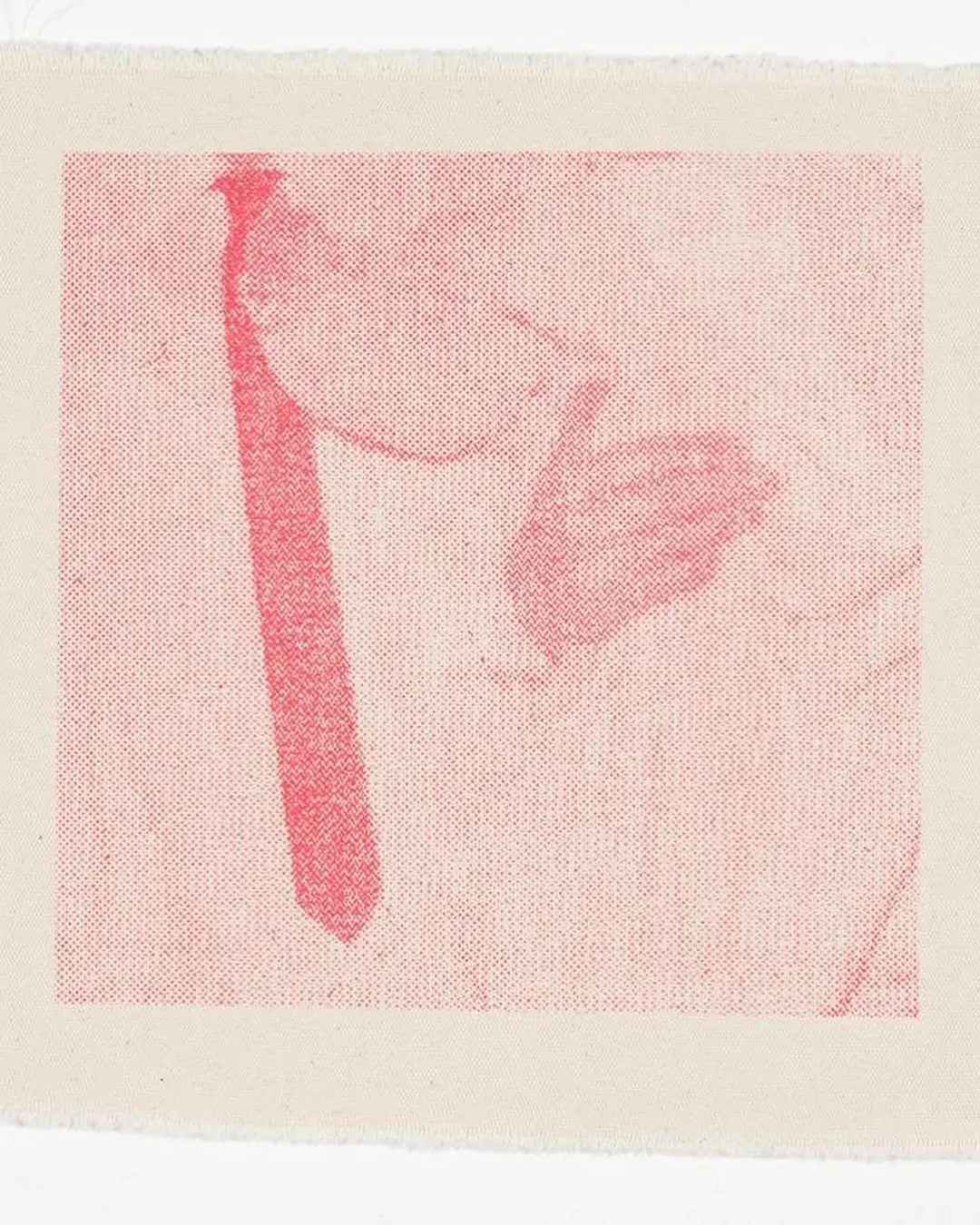
“I’m usually — if not always — drawn to the hands of people, and the points of contact between them.”
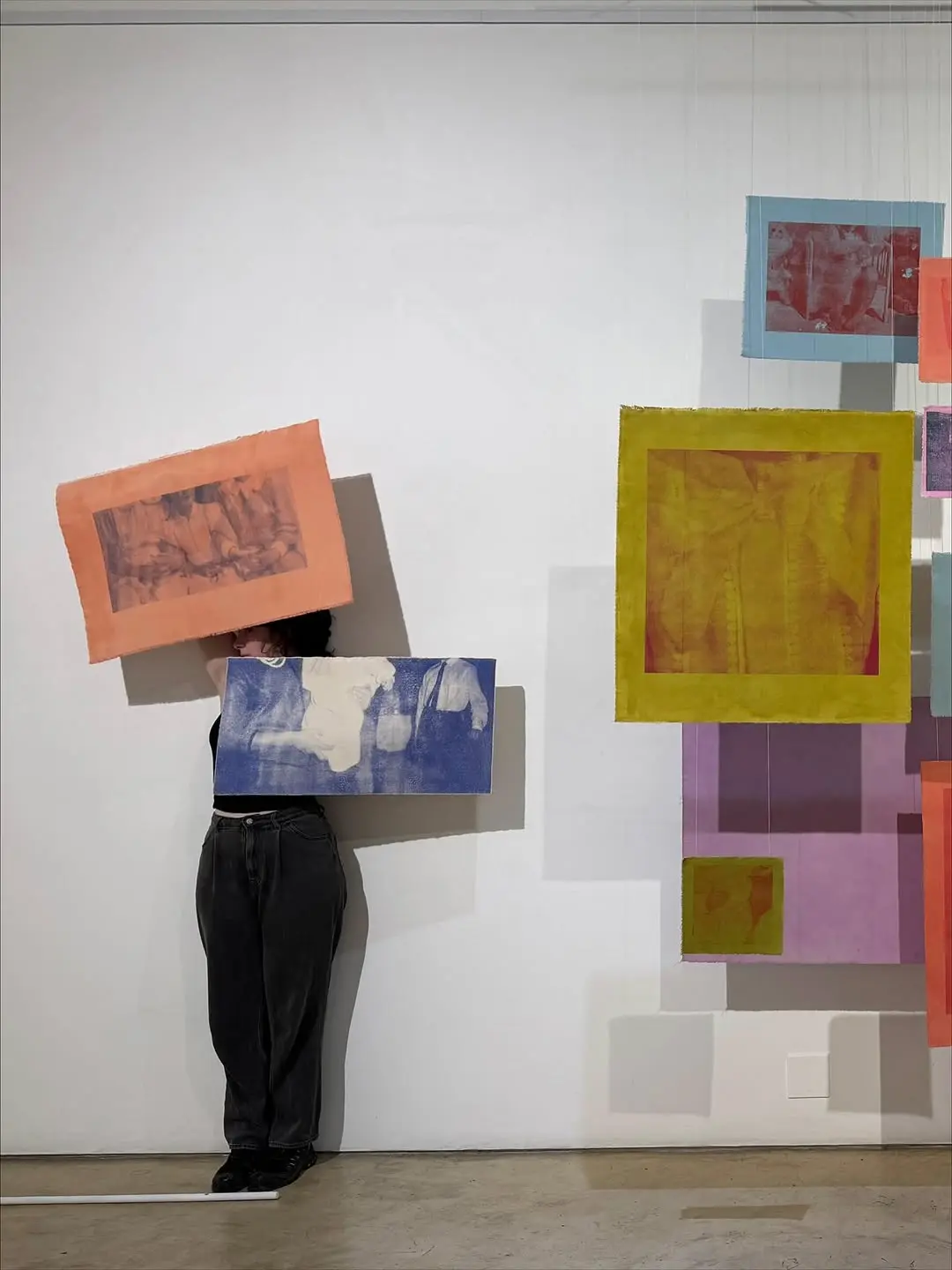
Nina Amongst Her Works, 2024
MR: You mentioned earlier that your process becomes quite layered, where does a piece start and where does it end?
It starts with collecting images. Any photographic material my family has, they send to me. Recently my aunt has been going through a difficult time, and she’s been sorting through boxes and boxes of photographs. We spent a day going through them together, and I was asking, “Can I take this one?” So now I have this pile from her, and some of the next works will come from that. It feels very connected. Then I digitise everything myself by scanning them. After that, I sit with the images for a long time, sometimes days or weeks, going through them over and over again, asking myself what I’m drawn to.
Then, I start cropping, making different versions, playing around in Photoshop, turning them into halftones and adjusting the dot sizes to see what suits the image best. I send those to a screen printing supplier in Montague Gardens, and they print them onto acetate. They also help prepare my screens. I’ve set up my own printing press, which has given me a lot more freedom, although I still rely on them for exposing the screens.
The screen itself is coated with a light-sensitive emulsion. The acetate is placed on top and exposed to UV light — wherever the image is black, it blocks the light, and those areas wash away so ink can pass through when printing, and the rest of the emulsion hardens.
In between all of that, there’s a lot of thinking about colour — what combinations make sense, why certain colours belong with certain images.
Then there’s the preparation of the canvas — cutting, ripping, laying everything out, deciding which pieces will have which backgrounds. I paint the fabric myself, often in batches, and I mix all my own colours.
MR: So you paint the fabric?
Yes, I paint the fabric. I use a roller. I like that process though, because you get these unexpected textures from the roller, or from older ink. Sometimes I’ll even use leftover ink and just squish it across the surface, almost like I’m screen printing directly onto the canvas, but it’s just me pushing the ink in.
I also like to paint them on both sides. Not all of them, but a lot of them have paint on the back as well, because then the colour becomes part of the shadow, it reflects onto the wall. I like that because it makes the work feel more expanded, like it’s not just the surface.
I really like the frayed edges too, it keeps everything feeling raw; I was trying to figure out how to hang them in a way that maintains the rawness — like they’re just floating pieces of canvas. I tested a few different approaches, and then when they were all installed together, I liked how they interacted with each other: it became more like one large installation rather than individual prints.
NZ: What about framing don’t you like?
I think it’s the formality of it. I like that the work feels exactly like what the process was, it feels more intimate.
Megan to Nina: What’s the reason for halftoning the images?
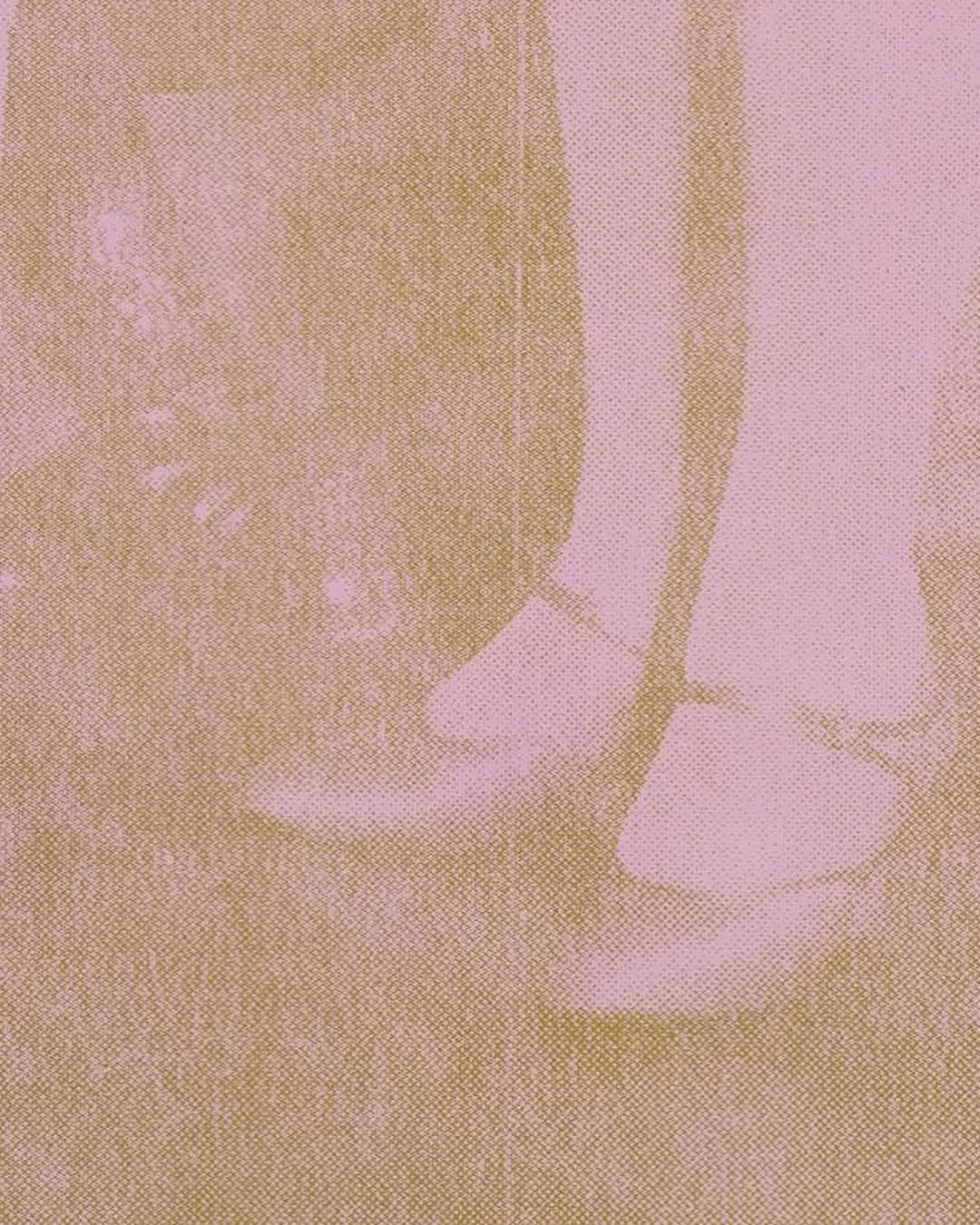
Nina to Megan With screen printing, you need areas where the ink can pass through, so you either work with solid blocks of colours and tones or something like halftone dots, which maintain the tonal variation of a photograph. You could also use lines, which I might explore, but the dots feel right to me. They feel blurry — more like memory. You lose information in the process, and I like that. Especially when you print onto colours that are quite similar, the image becomes even less clear. A photograph might be very detailed, but once it’s printed, it can be reduced to something much more ambiguous — just a suggestion of forms.
It starts to feel almost like a dream.
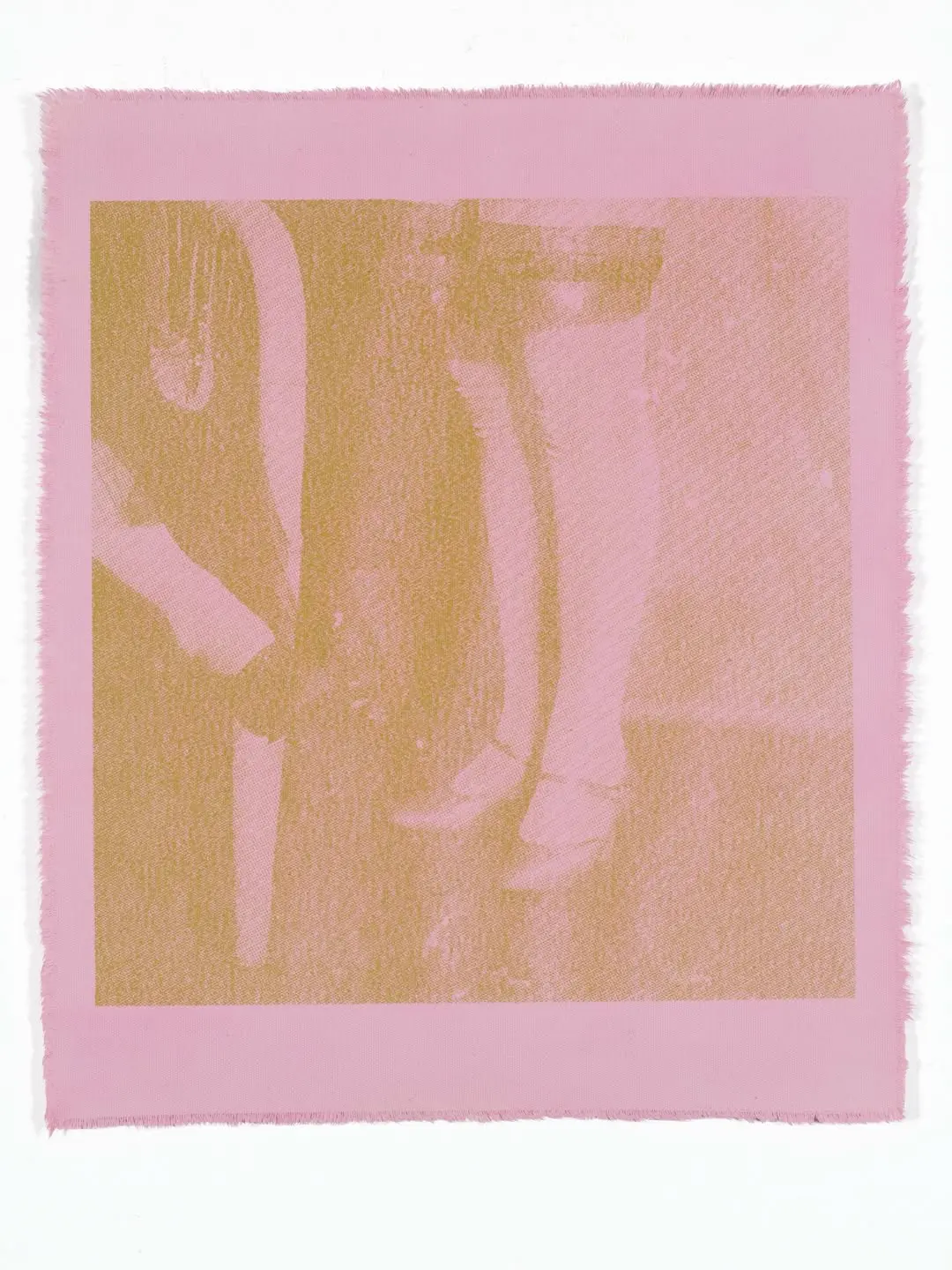
NZ: Let’s talk about colour a bit more. You’ve got your swatches here. Colour feels like a conduit for emotion in your work. Do you think of it as a kind of language?
I think it is, but I don’t know if I can fully explain it. For me, colour can carry nostalgia, or uneasiness, or create unexpected emotional combinations. For example, when there are babies or younger figures, I often go towards pinks and purples. But then I also like to take the same image and print it in something completely different, like green and red, and see how differently it’s experienced.
Even though it’s the exact same image, the feeling changes entirely. It makes you question why one colour evokes something specific while another feels completely different. And then there’s also colour relativity — how one colour shifts depending on what it’s next to. That plays a big role in how the work is felt, and how it affects you emotionally.
NZ: So you mentioned earlier that you didn’t really like working with blues, but what’s interesting is that piece you had at AVA — that was the first one I noticed, and the first one I took a picture of. It almost reads like a cyanotype to me, even though that’s not a part of your process.
There are a lot of similarities between cyanotype and screenprinting. I think that’s partly why I’ve avoided blue – to differentiate between the two processes. But I actually like that different mediums can overlap visually. It feels like it adds a bit of mystery to the process. But going back to the blue one, that was the first time I really leaned into blue. I’d used teals before, but that was the first proper blue. And people responded really well to it.
I think it was also the image itself, there was something about it, maybe the attitude. And I liked that response because it made me want to explore more in that direction.
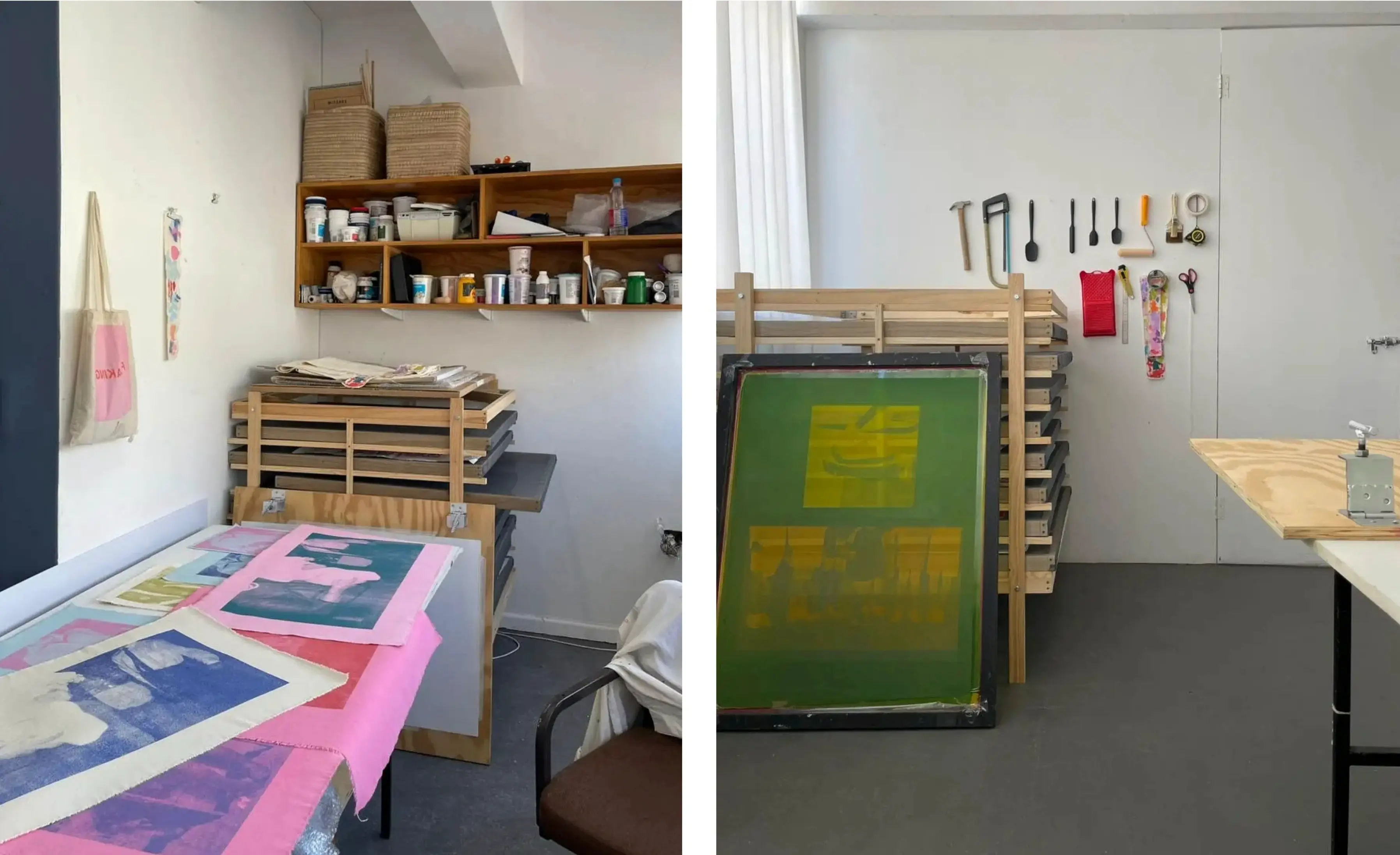
Anecdote Studio Visit with Nina.