in conversation with
Shakil Solanki
Shakil Solanki (b. 1997, South Africa) is a painter and printmaker currently based in London, where he is furthering his studies. His intricate, dreamlike works explore the shifting dynamics of intimacy, desire and identity. Drawing from the visual languages of classical Eastern art and his own South Asian cultural inheritance, Solanki constructs richly ornamented worlds in which tenderness and longing sit alongside moments of melancholy, tension and unease.
Central to Solanki’s practice is the recurring motif of the secret garden: an imagined, liminal space in which private desires, memories and vulnerabilities are allowed to surface. Often rendered through deep, nocturnal blues, lush vegetation and intimate figurative encounters, these spaces become sites of both refuge and tension. Through a distinctly queer reimagining of inherited imagery, Solanki considers the complicated relationship between culture and desire, creating alternative mythologies in which romance, sensuality and discomfort are permitted to coexist.
We met Solanki at Oula Café in London over the summer to speak about the worlds that exist within and beyond his work, exploring queerness, cultural inheritance, intimacy and mythology, alongside his evolving practice and its place within a new city.

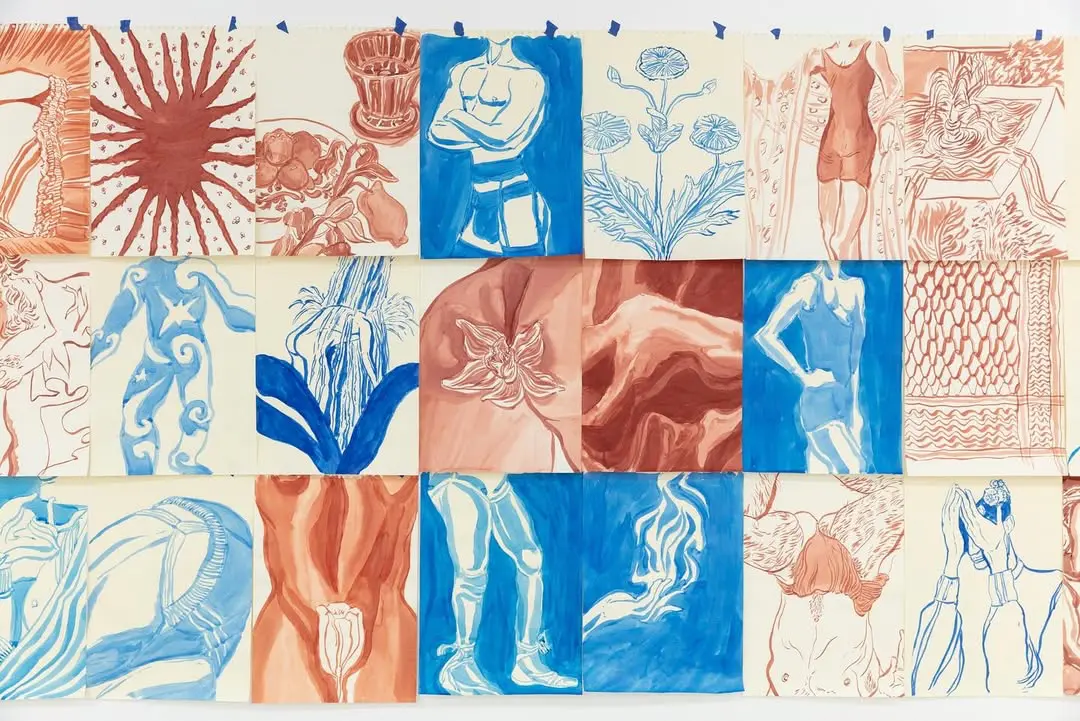
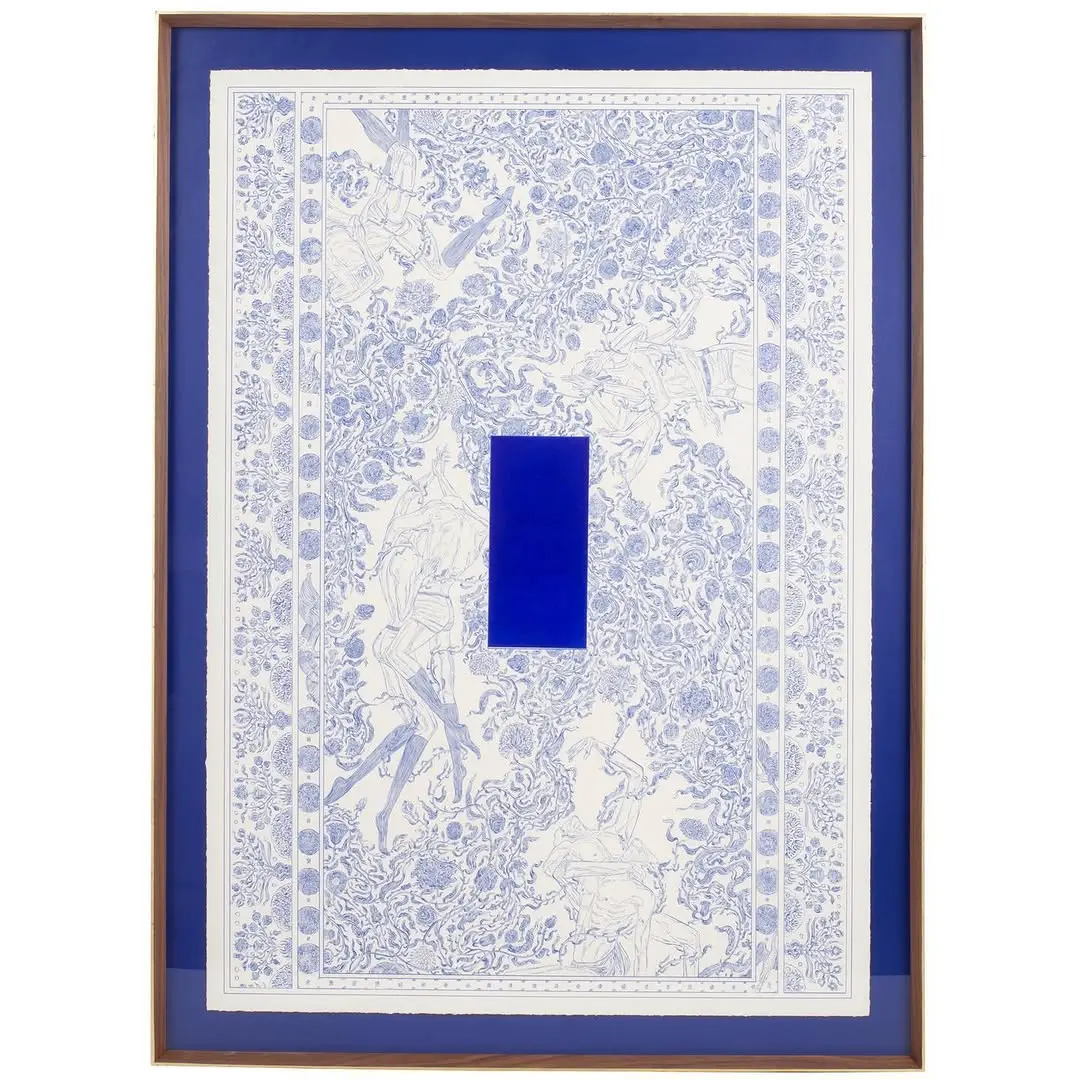
The Broken Fountain: 'Ephemera of Desire', 2025, ink on paper. Courtesy of Mario Todeschini & Breakroom
NZ: The last few years have been somewhat of a journey for you - from living in Europe, to moving to London to attend London College of Fashion. How has your workflow, your process, and/or the themes you explore changed as a result?
The past few years have been really… nothing has happened where I expected it would. Being in different places and experiencing just so many different things has shifted so much.
I’m never prescriptive about the way that I create work. I prefer to see it as a very generative process of just creating for the sake of creating. I keep a permanent kind of bank of reference of other artists’ work, whatever I’m reading, films, music, things like that. I have a visual bank that gets pulled, and then those get turned into sketches, turned into paintings.
Last year was a really formative year, both professionally but also personally in quite a big way. The year started with a fractured wrist. I’d come back from Europe and I’d been mugged in Paris, and my left wrist, my working wrist, was fractured; I spent basically six months in a cast, and in that time it was just this really weird summer period of, like, “What am I doing? Where am I going?”
Which was also partially how the textiles route came about; [I asked myself], “What are the other options? How can I diversify the skill sets, but also extend beyond the art world specifically?”
I think my injury was interesting because it forced me to kind of break out. I made a creative running series with my right hand - my non-dominant hand - which started as just five-minute sketches in my studio. They were intended just to be really quick, messy studies, but that actually grew into basically a series of about 150 drawings or pieces.
And I really learned to lean into - I don’t want to say kind of an “ugly” mark - but something that’s far less manicured or precise than I’d normally go for. I suppose moving [countries] and textiles has been a crazy new venture, but I think I’m only, what, eight months in now, and I’m only feeling a bit more comfortable with it on a technical level. I wish the MA was two years rather than one.
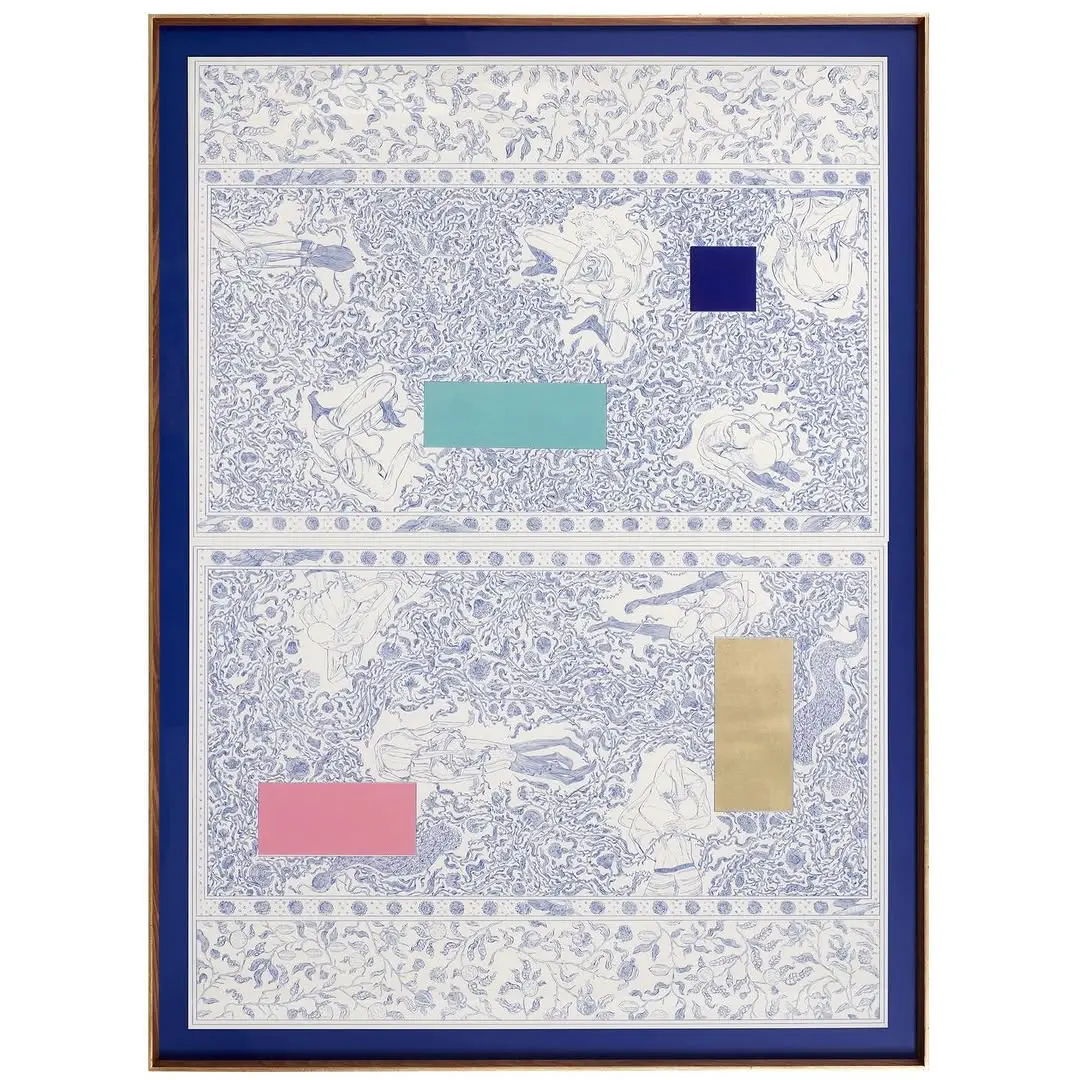
‘The little ears and springy curls, the cruel charming curve of his lips.’, 2021, diptych of silkscreen prints with chine collé inlay.
NZ: When I first encountered your work, it was at your opening at Everard Read, Superstar Images at the Taj, in Cape Town in 2021. It was all quite intricate then, with the linework reminiscent of figurations of Hindu Gods we saw growing up. Recently, for example, at Breakroom, where you worked with Igshaan Adams, we’ve seen you play with washes of blue and a slightly looser configuration in your paintings. When did that shift happen?
Over the years there’s been a permanent kind of push, at least from collectors - not so much the galleries - people are permanently saying, “Oh, we want scale, we want the art to be covering walls.” Which, I mean, is great. It would be beautiful, but it’s also just an insane amount of work. Even the miniatures take [a lot of time] - it’s not a quick little outing.
Even with creating the intricate works, I was starting to get motor issues in my wrist, which [inevitably] led me to ask myself, “Well, what’s going to happen now?”
Ink as a medium is something I really kind of dove into last year. I think the majority of my show at Breakroom was created with ink. I’ve really fallen in love with it as a medium; it’s just so delicate. You also need quite an insane amount of control with it, especially on paper. And I found there was a really interesting push and pull of how wet you keep the paper, playing with the staining and the bleeding, and what gets allowed to leak and flow more on the page.
And then, with Igshaan [Adams], the majority of that show was all of the larger paintings. He came for a studio visit and was really interested in my work. I spent two and a half weeks in residence at Breakroom. In the last few days Igshaan was like, “Come on, let’s just shake it up. Let’s kind of break out a little bit.” He was pushing me to paint on the walls. Generally, I’m a very tentative person, but even more so with the way that I work. There’s a lot of trepidation before things actually kind of get moving.
There was something really, really enjoyable about enlarging the body, also kind of the wash of the ink to that scale.
NZ: You’ve always appreciated a good garment and a good textile, and you’ve had collaborations with FIELDS before where some of your artworks were superimposed onto clothing; being where you are now, do you see yourself eventually shifting focus, bringing your printmaking and painting into making clothing?
No, to be honest, I don’t. I think being an artist or a creative in today’s age, I feel like you kind of have to take on a multi-hyphenate space to really make it work for you. Even just on a financial level. I feel like I would need the balance of both painting and textiles to make sense.
I’d like to get to a point where I could be making larger-scale tapestries, or a fully printed, embroidered painting, and vice versa. At the same time, I think collaboration is also a really key element of the textile and fashion industries, and that’s something that I’ve enjoyed with the fashion collaborations that I’ve done in the past. I enjoy how you can bring two artists’ languages together and how that can really bolster and support a collection or an exhibition. I wouldn’t shift entirely into textiles.
“I think being an artist or a creative in today’s age, I feel like you kind of have to take on a multi-hyphenate space to really make it work for you.”
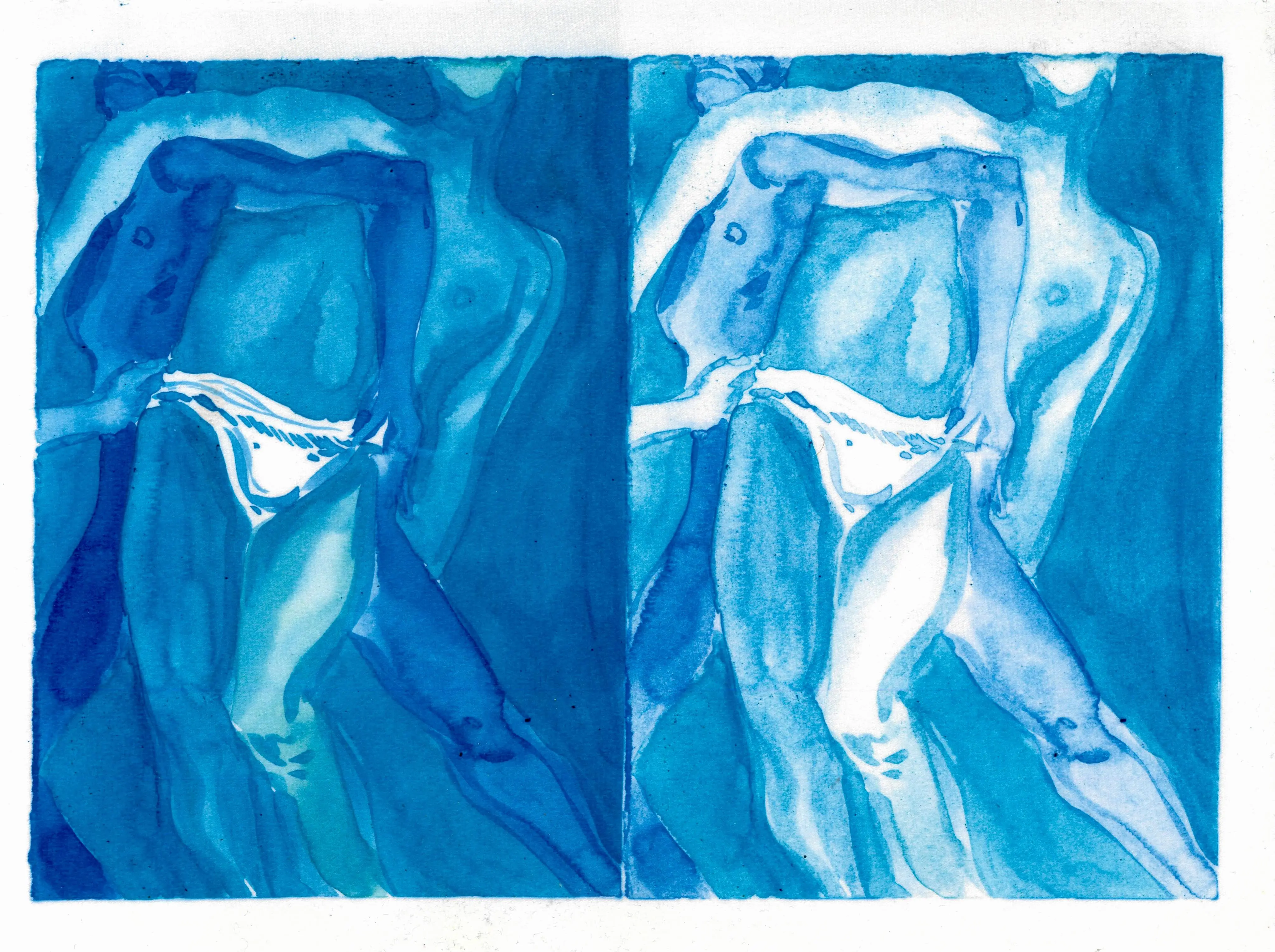
Dancers from the dance, 2026, dye sublimation on silk.
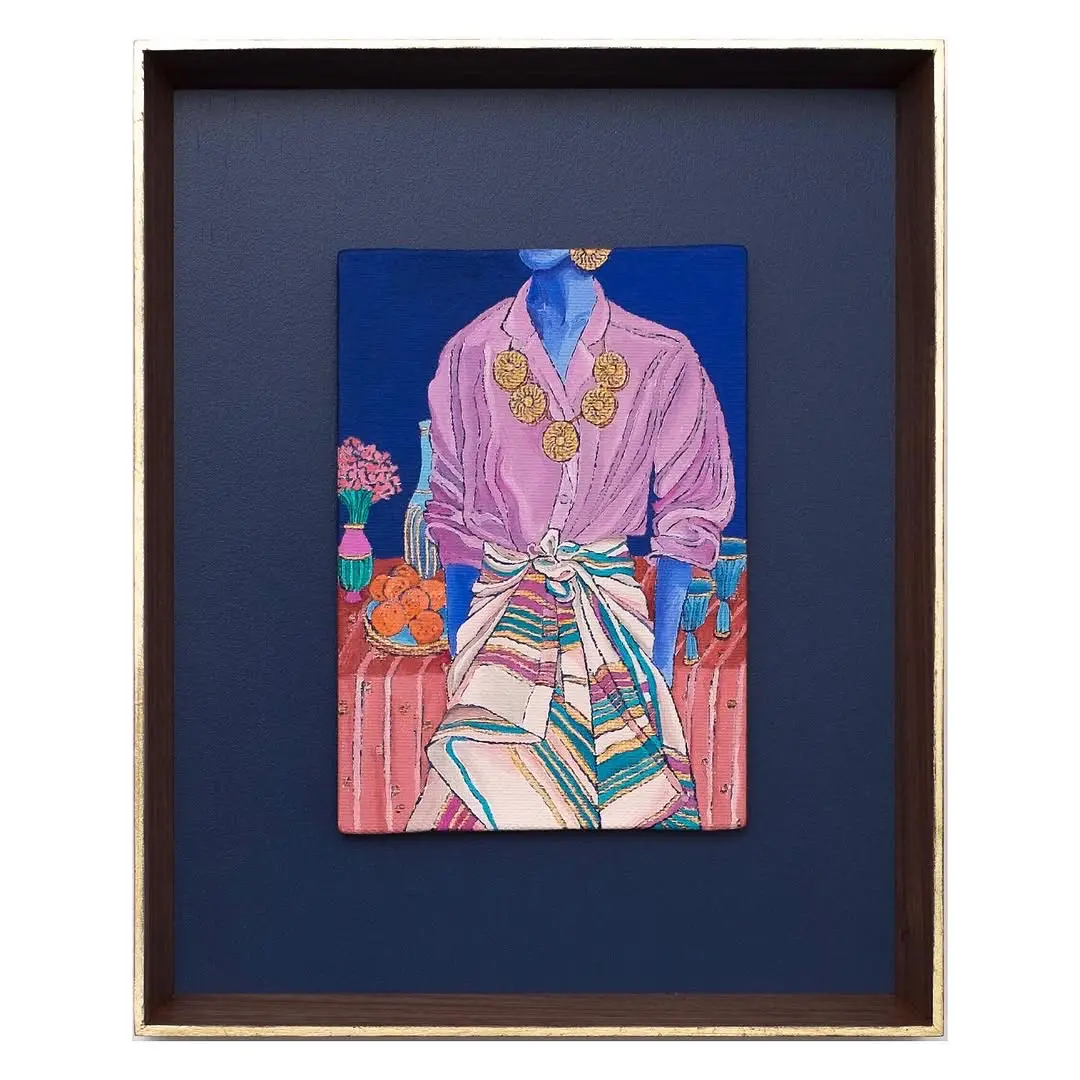
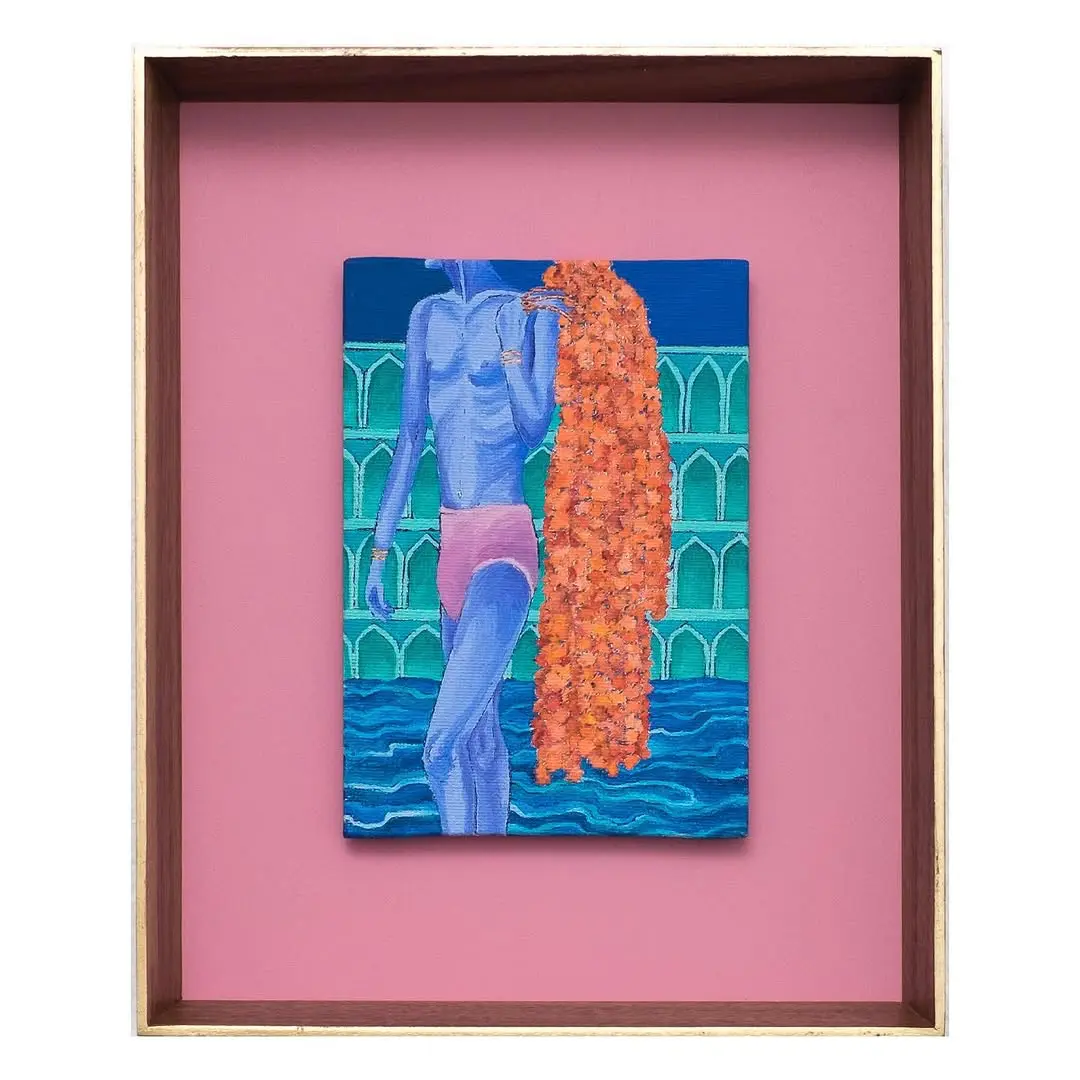
MR: Your work holds a certain intimacy; as a viewer, it feels as though we’re let into your universe in some way - with queer figuration, the ‘Krishna’ blue - but you often omit the face entirely. What’s that about?
Just as kind of a general rule, I tend to omit faces and penises, just because I feel they demand too much attention from the viewer. As soon as either of those elements are present in a composition, the viewer’s eyes are immediately drawn into that.
I think it takes a really gentle hand to kind of paint a face or a penis as well. Artists like Louis Fratino, Salman Toor, Oliver Scarlin - they paint so beautifully, and I can’t bring myself to do that.
But I think beyond that, I’m also more interested in the language of the body. I think there’s so much more that a body can suggest through its movements and gestures. I think especially after taking on ballet a few years ago, it’s something that’s made me appreciate that far more. But even looking into Indian dance forms like Kathak and Bharatanatyam, they’re narrative movement devices in themselves, which are just so incredible.
“I’m more interested in the language of the body.”
MR: Is there a process or a method of making that you are curious about but nervous to explore?
I’m permanently on the fence about dabbling more in oil. I feel like oil painting is such a… it’s something I’ll dip in and out of maybe, like, once every few years. I find it so intense.
It’s still abstract to me. Because a lot of my close friends are really, really fantastic painters who have a real kind of mastery over the medium, I’m more inclined to stick with my gouache and ink. But I think there is a really luminous quality to it, which someday would be great to get into.
MR: How has your relationship with colour changed as you explore your new trajectory?
Colour’s always interesting, I think. There’s permanent ebbs and flows of falling into permanent, rather deep, or really blue periods, and then lifting a bit out of that; also realising how you need the presence of other tones and other hues to really strengthen the blue that is present. With textiles, my course at London College of Fashion has involved a very different way of working. The last project that we did was based on an industry brief, so it was going to be a lot more commercial in the way that I work.
I’ve been forced to sit with the significance of colour, delving into what different colours mean and signify. That’s a whole kind of language itself, which I’m still really interested in.
NZ: Your artwork titles are often quite sweet, poetic. Where do you draw those from? Are you writing them yourself? Are they lyrics translated in English?
Back to the bank of references I mentioned earlier, I keep it running as I am reading. If there are any quotes or phrases I like, I’ll take those down and go back to that later when I am trying to find artwork titles.
The quotes are generally from queer literature, or what I’m reading at the moment, which feels like a nice way of connecting the work to a broader landscape of queer or homoerotic context and thoughts. Otherwise, song lyrics, Bollywood or Hindi lyrics, I write the odd poem myself… my artwork titles are a mixture of all of those
I think that there’s something about a title which can really kind of anchor a work so beautifully. So I try to be kind of as decisive, or at least as precise, as possible.
MR: How do you protect the parts of your practice that are still forming?
Having a strong, precious group of friends and artists around me whose thoughts and opinions I can trust. Feedback as well - I tend to keep things very close to my chest generally, but letting the right people to bear witness to my process becomes quite special. I’ve found that I’ve really been able to rely on my friends to bring in support and constructive feedback. It’s been a constant as I move through mediums and cities.
“I tend to keep things quite close to my chest.”