in conversation with
Shayna Arvan
Shayna Arvan (b. 1997, South Africa) is a Cape Town-based painter and illustrator whose work is marked by an intimate tenderness and sensitivity to atmosphere. Currently, working primarily in paint, with an undercurrent of drawing, her compositions often move through soft palettes and intimate gestures, allowing moments of vulnerability to surface within the artwork.
Arvan’s practice engages with the subtle emotional textures of everyday life, where fleeting moments, private interiors and romantic, nostalgic fragments come to hold a heightened presence. Her works feel suspended in time, lingering between observation and imagination. Through delicate and inward mark-making, Arvan creates images that feel both intimate and slightly elusive. Her paintings invite the viewer into a reflective encounter; where familiarity, memory and resonance find their place between the viewer and the work.
Arvan invited us into her studio to explore the undercurrents of her work through exploration of vulnerability, intimacy and the pursuit of negotiation between her interior moments and the shared cultural experience.

MR: Your paintings often feel steeped in atmosphere — there’s a sense of heat and intimacy in them. The close-ups, even something like the back of a neck, feel very intimate, almost suspended in time. We’re curious how that atmosphere develops in the studio. Is it something you consciously construct, or does it just happen as you work?
I feel like with the paintings, I never really do anything consciously – well, I’ll consciously decide on an image, and it’s interesting to see how the atmosphere emerges, but I don’t think beforehand “I want to create an intimate atmosphere”. The process itself does become quite intimate, I spend a lot of time with the paintings and work very closely to the surface, this prolonged attention inevitably creates some sense of closeness or attachment.
I don’t know what atmosphere they might carry for the viewer, but for me, they hold the time in which they were painted. When I look at them I can remember how I felt while painting, what podcasts I was listening to. I don’t know how other people experience them – it’s interesting to hear what they feel – but for me, they’re very much tied to a specific emotional duration. The atmosphere isn’t something that is consciously constructed, it’s something that accumulates
MR: Do you reference pictures, or are these images that come to you?
I do use reference pictures. I’ll use a reference mainly to get the lighting right, and sometimes for proportion. But once I’ve got the basics down, I try to move away from the reference and work more from intuition and what feels right.
I’d like to get to a point where I can construct everything completely from my mind, but things look so different when you’re actually painting them. You might think you know what an ear looks like, but when you break it down into paint — into colour, shape, and texture — it’s not the same as how it exists in your head.
MR: There is a tactile quality to your surfaces; gestures and material feel inseparable from emotion. How do you think about touch and physicality in your painting process?
I’m really interested in trying to capture textures. That’s something that will draw me to an image. I’ll see a texture and think, I want to see if I can get that with paint.
I want people to want to touch the work. I like looking at paintings that I want to touch. I’m interested in touch, and in trying to capture touch within the painting itself. There are works where hands are touching, but I’m also physically touching the work so much while making it.
I guess I want people to want to feel it. I want it to look gooey or soft or biting. I’m most interested in getting some type of texture or desire to touch — something tactile.
NZ: So, the title I Love Hot Nights evokes something sensual, but also quite restless — maybe even cinematic. When we spoke about it, we thought of the film Palo Alto. How important are the titles you choose in framing the emotional or psychological entry point into the work? Often people look at the painting and then they look at the name.
I hate titles. I hate having to do titles. I try not to put too much thought into them — it’s kind of whatever pops into my mind at the time, or maybe what song I was listening to.
There were three paintings I did recently for the portraiture show at Girls Girls Girls Gallery. I didn’t know what to call them, but I’d really been loving “Human” by The Killers at the time, so I took three lines from that and used them. I don’t think too much about the titles.
I hate titles. I hate having to do titles. I try not to put too much thought into them – it’s kind of whatever comes to mind in the moment, maybe something from a song I was listening to at the time, sometimes an inside joke with myself. Titles are complicated because they do play a big part in how the work is perceived, but I want the painting to stand on its own. Unfortunately you have to title them. I’ve thought about just calling them “Untitled” and numbering them.
Megan to Shayna: Going the Rothko route.
Shayna to Megan: Yeah, I think I might have to go the Rothko route. A lot of the time I’ll title something and then change my mind, and then the same painting ends up having three different titles in different publications or contexts. So maybe sticking to “Untitled” would be better.
NZ: While you were speaking earlier, I began thinking about the fact that there is an intimacy that each of your pieces carries. It feels like peeking into a moment you’re not necessarily a part of, but that is somehow in full display to you — and not in a voyeuristic way. Is intimacy something you want to capture intentionally? What makes you choose your subject matter?
I wouldn’t say I intentionally hunt for images that convey intimacy, but those are the moments I’m more drawn to.
I like that it feels like you’re getting a glimpse of something that might not be meant for you, maybe little naughty, maybe a little creepy. I think these are the most intriguing moments, they hold the most feeling for me. L ovely and disgusting. They’re human. And it’s interesting how things that feel so intimate and personal are actually quite universal, it’s something we all share. We’re all kind of the same in some way in the end.
We’re all kind of the same in some way in the end.
NZ: Following on from that — how do you negotiate the space between what might be a private memory you’re capturing and something that shifts once everyone looks at it? Like you said, these intimate things are also universal. How do you balance the personal and the collective?
I mean, I don’t really think about that while I’m making the work. I en j oy hearing afterwards from people who feel that it resonates with them for some reason. but I’m definitely not thinking about finding a balance between the personal and collective when I’m working. I think they inevitably tie in.
I’m not fully aware of how – it feels beyond my comprehension in a way. Sometimes you’re j ust a vessel. It’s easier when you think of it that way because there’s less ego and pressure involved. I don’t know if it’s a higher power, but sometimes it feels like it comes from a place that’s not entirely unique to you; and because of that, I think other people connect with it. It comes from some part of the mind that is human and collective.
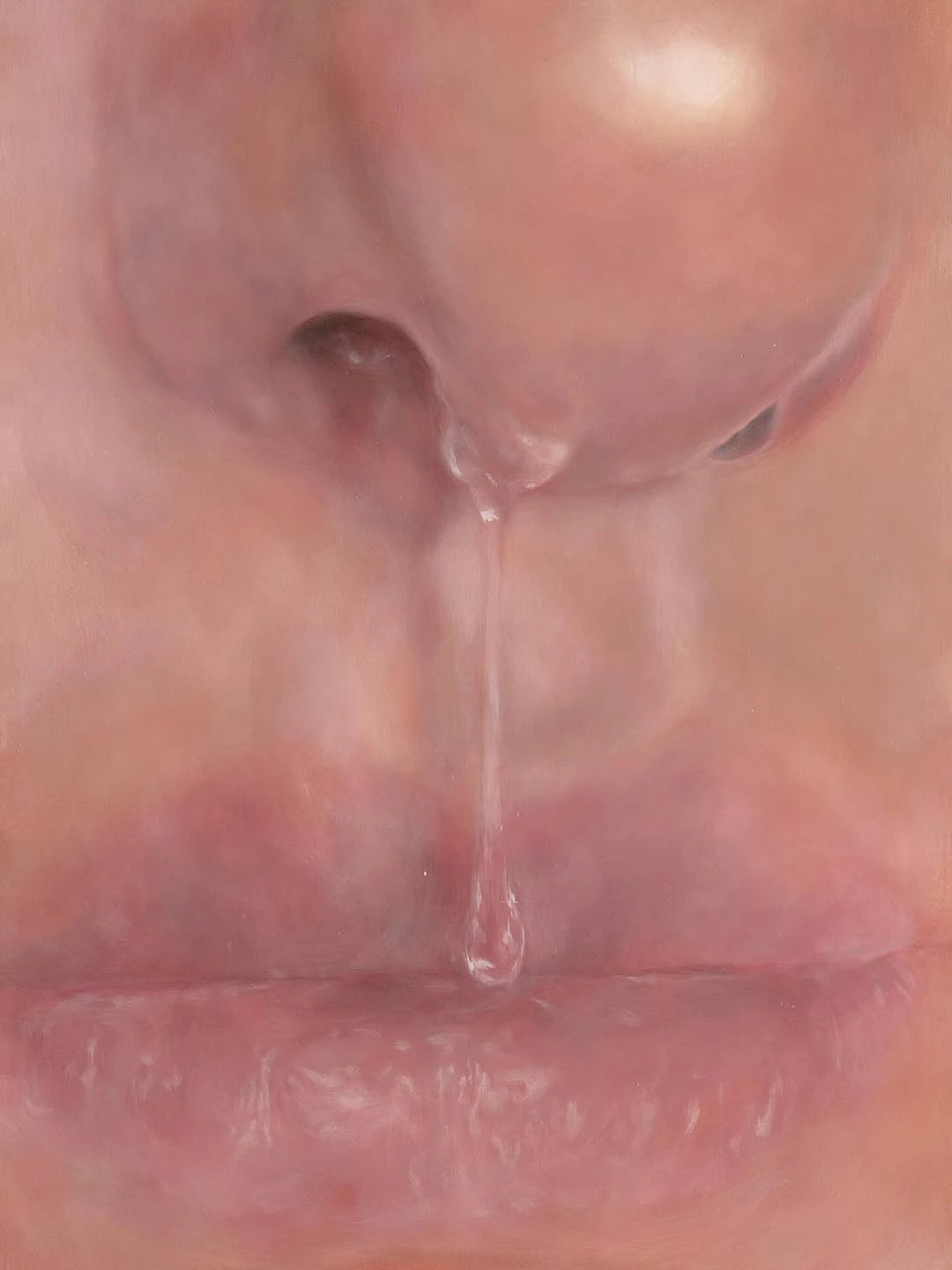
“I don’t know if it’s a higher power, but sometimes it feels like it comes from a place that’s not entirely unique to you; and because of that, I think other people connect with it. It comes from some part of the mind that is human and collective.”
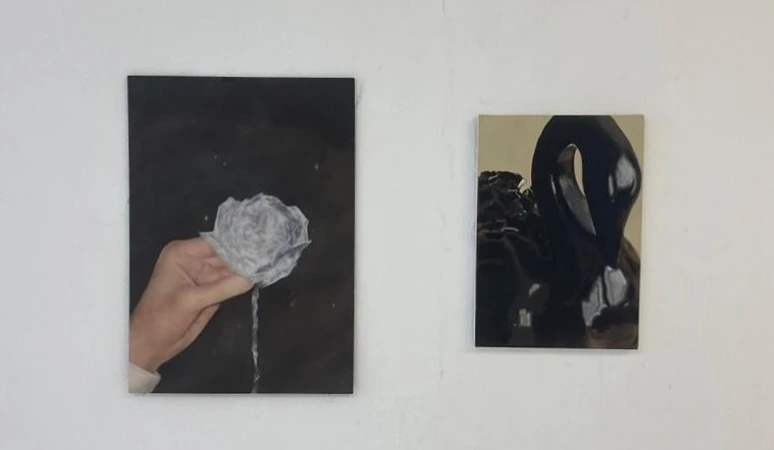
Shayna Arvan and Emma Belsham’s work as featured in their inaugural solo exhibition, titled “On the tip of the tongue” (2025)
Namrata to Shayna: I’m just thinking of the independent show [with Emma Belsham] again, because there were quite a few works that you could just stare at for a long time, which doesn’t always happen. Sometimes you go into a gallery and you just look at the work, sometimes it takes you in. I think looking at art can, at times, feel like a spectator sport.
Shayna to Megan and Namrata: Yeah, I don’t want that.
MR: Vulnerability can be a powerful yet precarious position, especially for an art-maker. What does vulnerability mean within your practice?
I feel vulnerable with every piece. And the way I hold that is just by accepting it and pushing through. I think I’ve learned — especially over the last year — that you don’t really have a choice but to move through vulnerability, in art and in life. It doesn’t feel good. It’s very difficult to hold. But you just have to do it. You have to hold it.
The opening night of the independent exhibition — I hated it. I hated it so much. I wanted to hide and cry. Not because it was bad — I was happy with the turnout and that we’d done it. It was amazing. But it was overwhelming.
It’s not easy to hold vulnerability. I’m still learning how to. But there’s no way around it.
NZ: If your work could hold onto one sensation for the viewer — something that lingers after they leave the space — what would you want that to be?
I don’t know exactly what I want someone to feel, but I would like for them to feel something. I don’t want someone to look at the work and feel nothing – that would be sad. If someone looks at it and feels gross or weird I wouldn’t mind that. If someone looks at it and feels excited or emotional, that would begreat too. I just don’t want nothing.
I mean, I’d love it if someone felt they wanted to buy it – that’s a feeling I’d like them to have. A friend once described the work as “sticky”, which I liked. I’m thinking about what I’ve felt when looking at paintings I’ve appreciated and sometimes it’s even something you don’t like that sticks with you. I guess it’s about something that sticks.
I don’t have a specific sensation I want to impose, but I would like for the work to linger.
“The opening night of the independent exhibition — I hated it. I hated it so much. I wanted to hide and cry. Not because it was bad — I was happy with the turnout and that we’d done it. It was amazing. But it was overwhelming.”
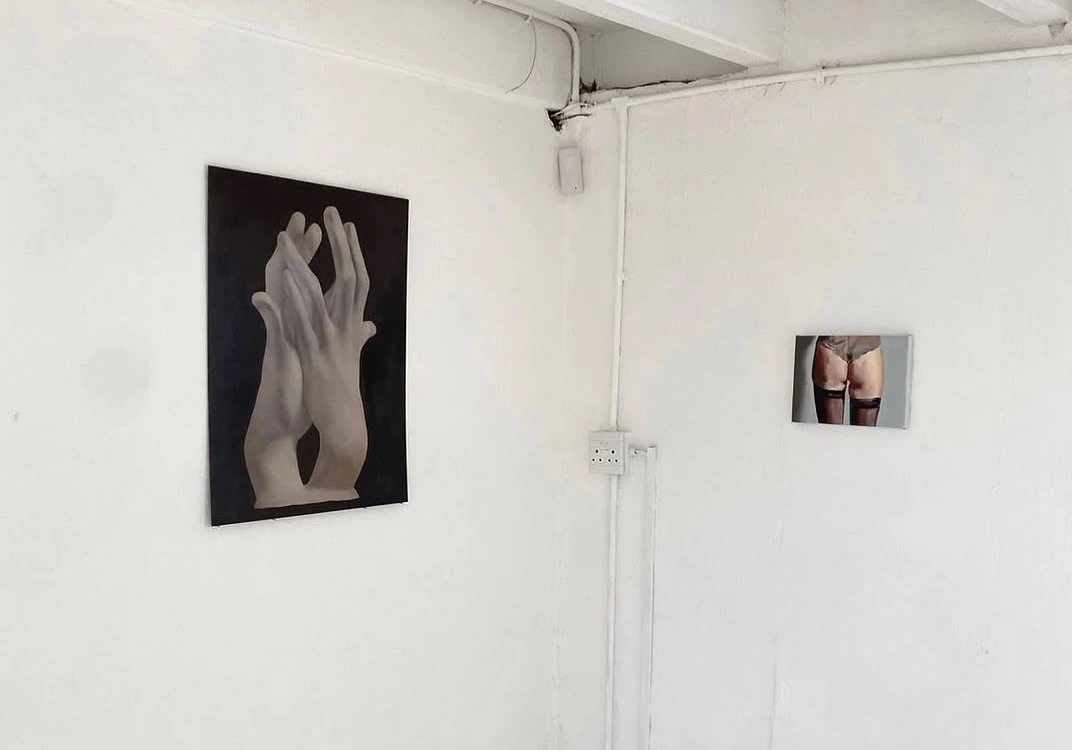
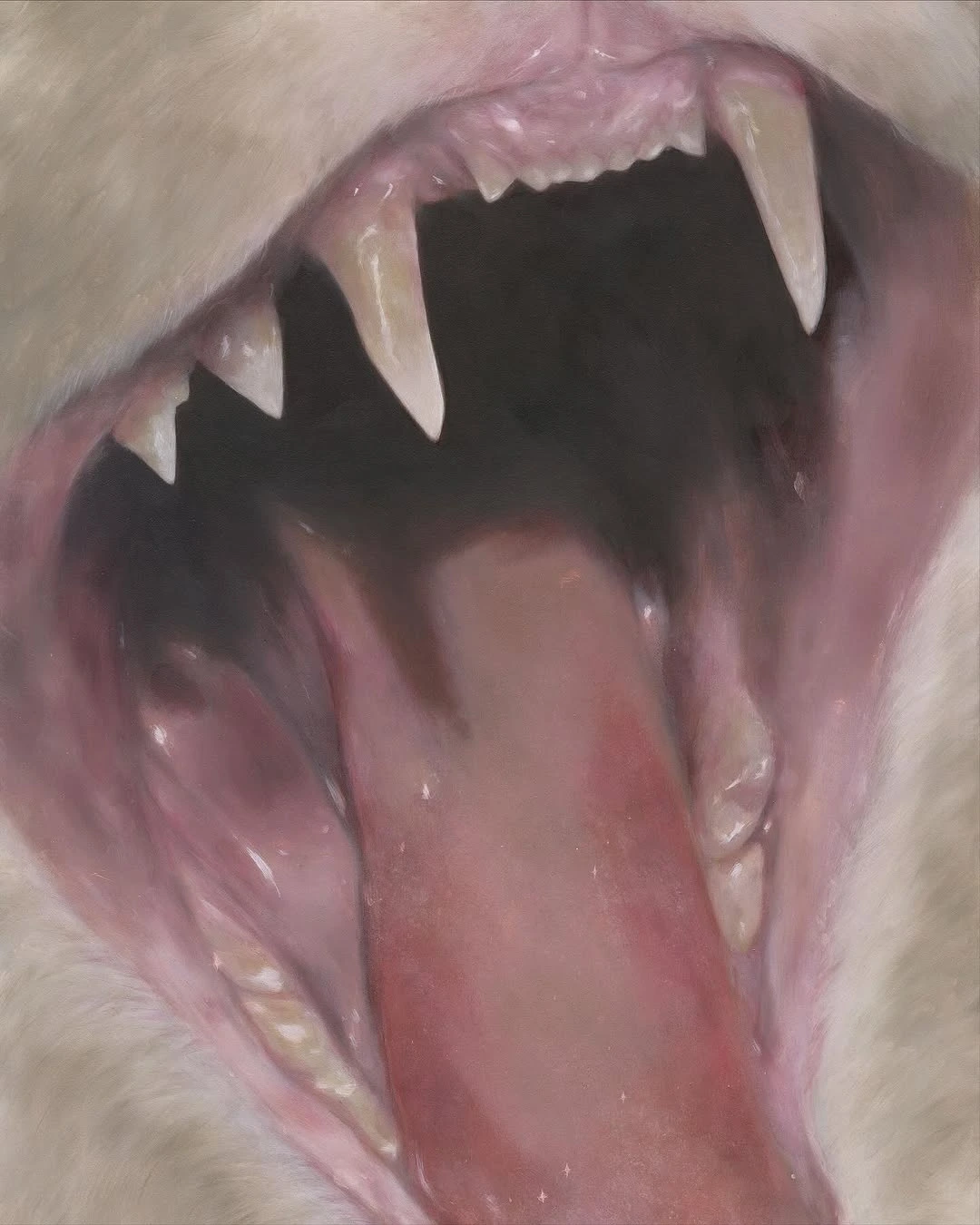
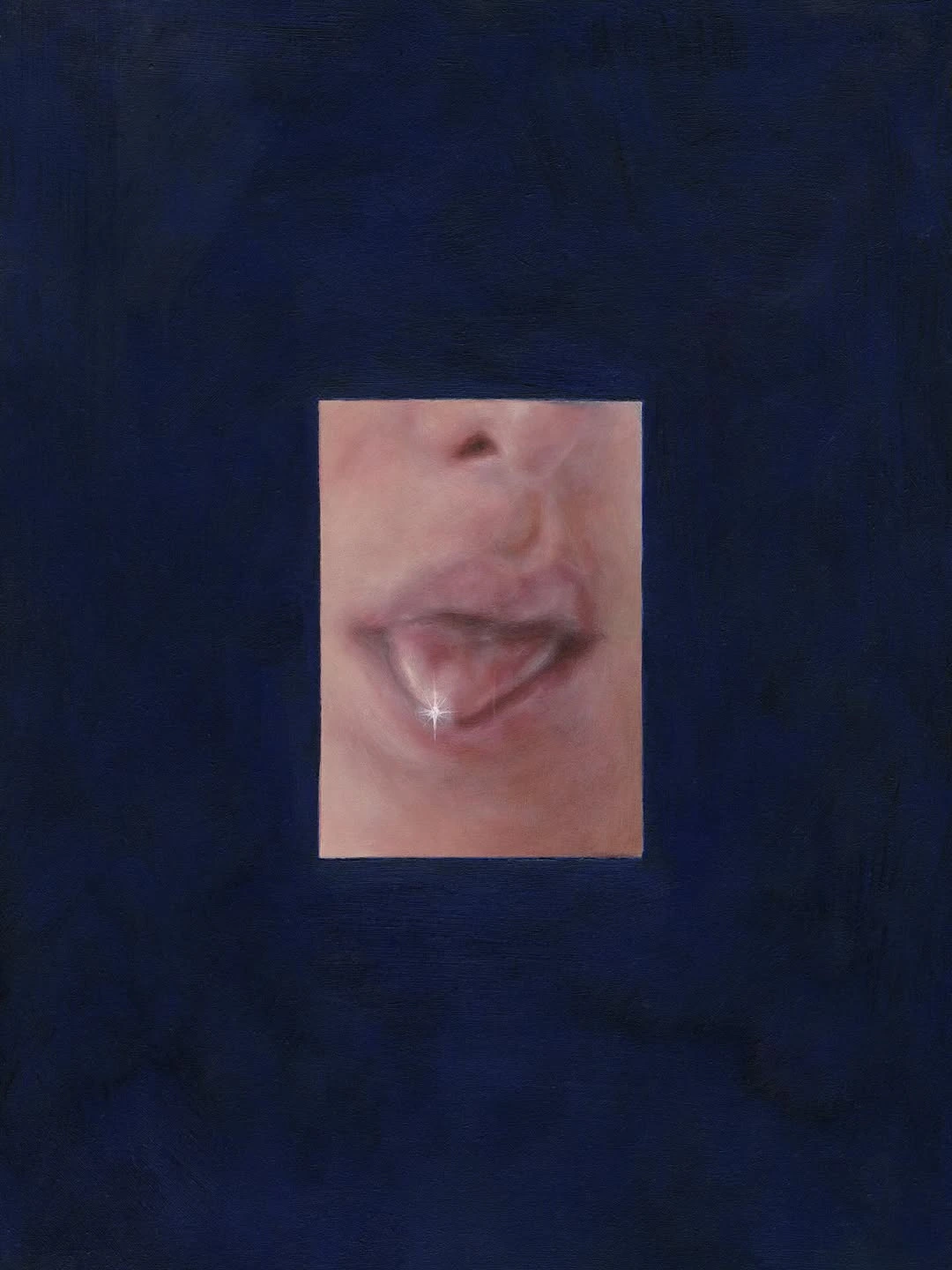
Shayna Arvan and Emma Belsham’s work as featured in their inaugural solo exhibition, titled “On the tip of the tongue” (2025)
Music is an integral part of Shayna’s practice. As part of our collaboration, Shayna has curated a playlist to let us into her world.