in conversation with
Alexa Brews
Alexa Brews (b. 2002, South Africa) currently finds herself at the intersection of fashion design and experimental biomaterial art practice. Rooted in an interest in materiality and texture, her work considers the quiet constraints and complexities embedded within femininity. Drawing on a background in fashion design, Brews extends her knowledge of fabrication and garment construction into the development of her own organic biomaterials; allowing the material itself to take on an almost living presence.
Within her latest body of work, material becomes both the subject and the medium. Brews’ practice explores the abject, engaging with the uneasy spaces of ageing, imperfection and transformation. Through surfaces that appear fragile and porous, her work reflects on what it means to inhabit a body in constant flux. Texture and tactility remain central to her approach, inviting viewers to reconsider conventional ideas of beauty, permanence and the boundaries of the human form.
The non-committal undercurrent of biomaterial is one she closely resonates with deeply in relation to how she situates herself as an artist. On a Wednesday evening in March, we joined her in her newly adorned studio, and got a window into her practice and the direction she senses it unfolding.

NZ: You began in fashion design. What prompted the shift from making clothes and garments to what you do now?
I always did quite avant-garde fashion design. The place where I studied, Fedisa, was very much against that. The institution is largely geared toward preparing students to work for big fashion houses in South Africa. So the way they taught us didn’t really encourage other ways of thinking, especially if those approaches weren’t commercially viable.
Even our assignments were very strictly briefed. For example, we might be given something like a catalogue brief for menswear, and there was only so far you could push that.
At the end of the degree we finally had a project where we had a bit more freedom. It was actually the first non-briefed project we’d had in two and a half years, which is kind of crazy to think about. For years you’re told exactly what to do, and then suddenly they say, “Okay, now do your own thing.”
I used that opportunity to make something much more theatrical and godlike and not really wearable. It was the first time I felt like I actually got to do something that aligned with how I wanted to think and make.
It was also the first time I felt like I was thinking in a way that was developmentally important for me. When I left Fedisa, even though I’d studied for three years, I still felt like I didn’t really know what my practice was because I’d never had the opportunity to think about what I actually wanted to do.
I decided I wanted to keep studying. Cara [Biederman], who has always been my best friend — she even modeled for my final fashion exam — suggested that I apply to study art. She said the way I approached fashion was already closer to art, because it wasn’t really about clothing having a practical function. So I applied to study at CTCA and jumped on that quite quickly. It all made sense to me, and I’m glad I did.
But, it was really, really hard. It was a difficult transition, more than I had ever anticipated, but yes, that’s how I ended up here.
MR: What was your thesis topic?
My thesis topic was on queer utopianism.
More specifically it dealt with a kind of critical utopianism — the idea of reaching toward utopia through negativity rather than imagining a fully realised perfect world.
The title was very long, like most thesis titles. It was something like Hope and Hopelessness: Queer Utopian Desire, Futurity and the Politics of Affect.
So it was about that, but it also connected to temporality in my work. That connection came from working with biomaterials and thinking about caring for something that you know isn’t necessarily going to last — something that has a lifespan and exists within decay.
I was very proud of the thesis once it was finished. Holding the bound copy was strange. Suddenly there was this physical object documenting two years of work.
I remember feeling oddly emotional about it. It was embarrassing. It felt like the end scene of the Superman movie — where the Iggy Pop song [Punk Rocker] plays and you realise everything is going to be okay.
But I was very happy. I worked very hard on it. For the last couple of months I barely saw any of my friends. Strangely it made the process quite calm. It wasn’t a frantic panic at the end — I was just very focused.

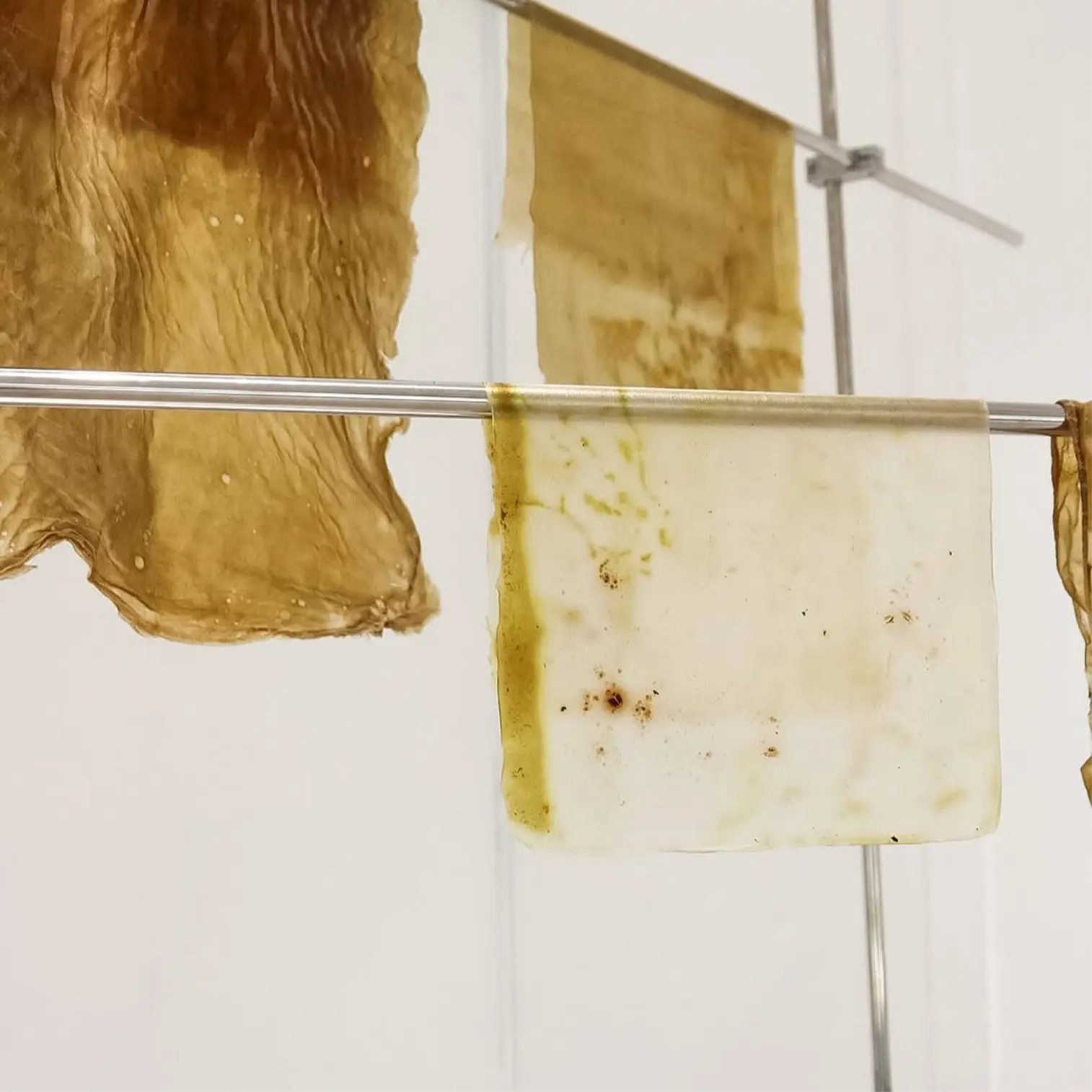
Network 1 (2025)
“I remember feeling oddly emotional about it. It was embarrassing. It felt like the end scene of the Superman movie — where the Iggy Pop song [Punk Rocker] plays and you realise everything is going to be okay.”
NZ: Do you see your biomaterials as an extension of the fashion thinking you developed during your time at Fedisa, or as a deliberate departure from it?
So interesting. I think it’s both, which I actually ended up writing about.
First of all, biomaterial itself largely comes out of sustainability conversations within the fashion industry — especially around leather alternatives. That’s probably the biggest context in which it exists in fashion. So in that sense, you can’t completely separate it from fashion.
But that wasn’t really my primary motivation. I wasn’t engaging with it from a strict sustainability angle. I was more interested in its corporeality — the abject space it can occupy, the bodily quality it has.
When I first started art school, the corset piece was actually the first thing I made. I’ve always been interested in the body. In fashion school I focused on corsetry — I love corsets for many different reasons. So I arrived thinking, okay, I’m going to do the thing I’m good at.
I used a pattern from something I had made for my Fedisa graduate collection — an understructure — and I tried to remake it in this new material. But the biomaterial really didn’t want to be a corset. That’s not how it exists. It isn’t woven. When you puncture it, it tears. The first time I showed it on a model, during what was meant to be a fifteen-minute review, I think within five minutes it started reacting to her body heat and shifting.
So I tried to do biomaterial “as fashion,” and it became this whole negotiation about how much I was allowed to intervene in what it wanted to do.
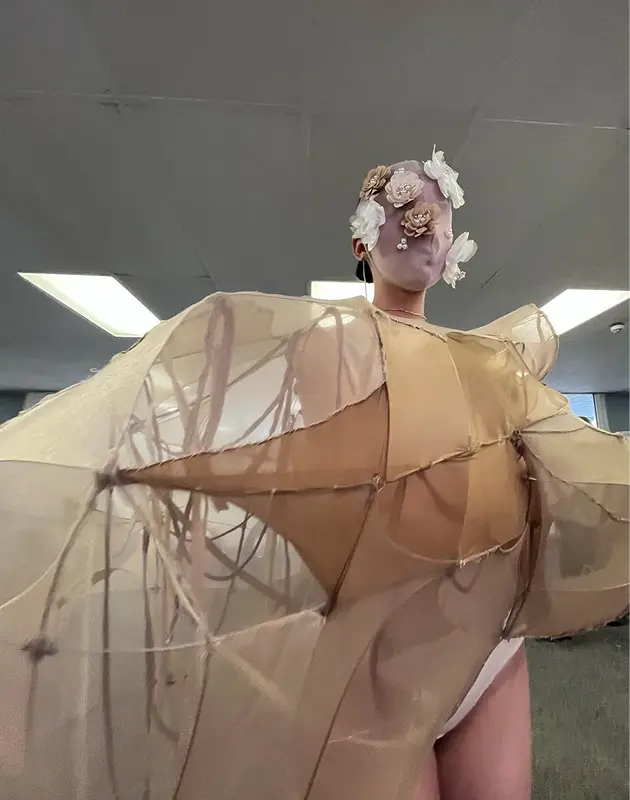
I hated that corset piece for the longest time. I didn’t even want to include it in my graduate show. But when I started writing about the work, I realised it was actually very representative of the past two years — it showed how my thinking had shifted and how I’d started to see the material differently.
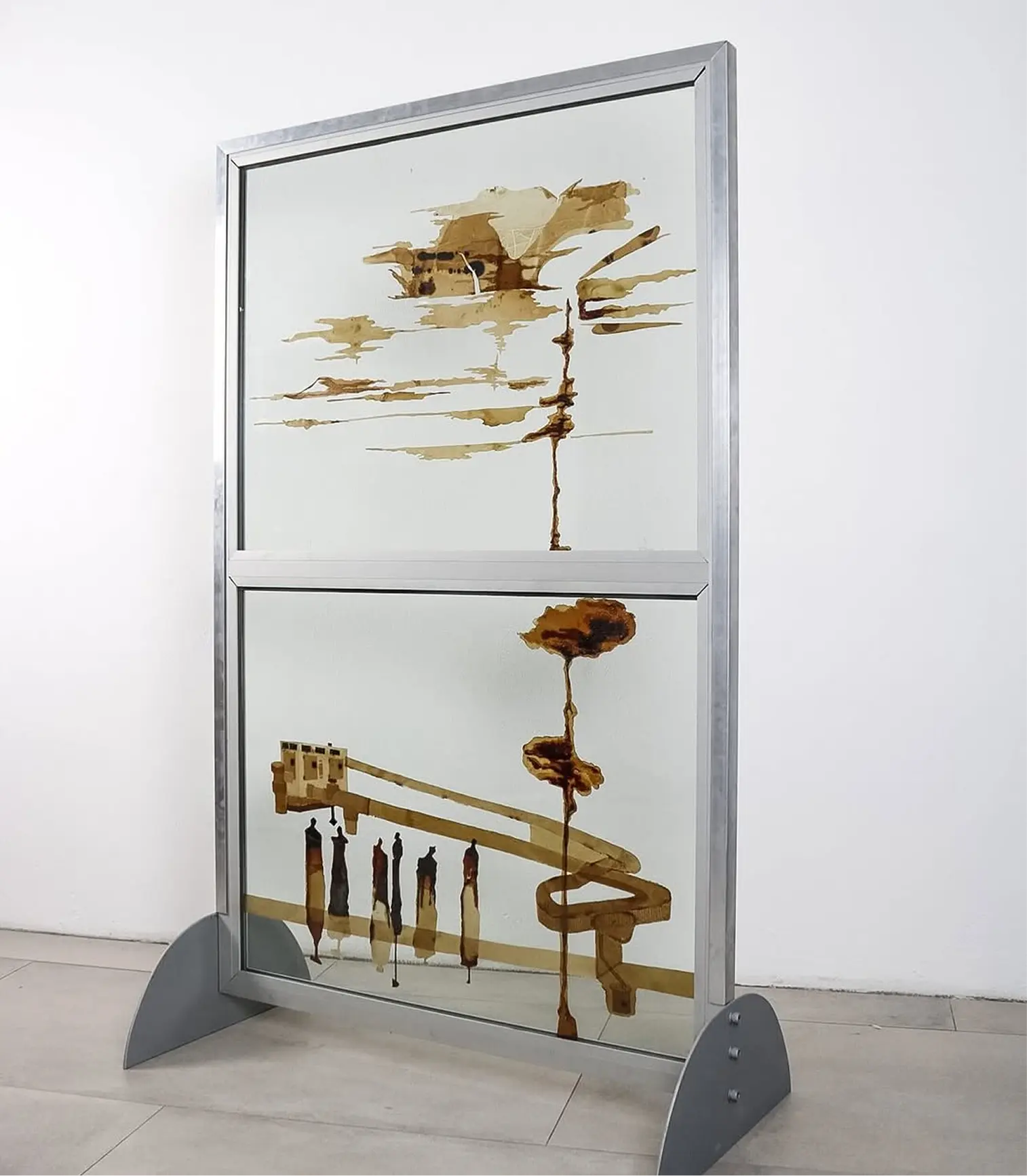
Ou-topos, Eu-topos, Even (2025)
MR: When I look at the work it almost looks woven. Is there any weaving involved?
In some pieces, yes. Not in all of them, but in some works there is a kind of woven structure. For example, the larger piece in the show has some elements like that. But it’s not woven in the traditional sense. It’s more of an improvised structure that interacts with the biomaterial.
NZ: I think sustainability is interesting as an underlying element of the work. A lot of artists don’t really engage with it, so it’s interesting that it appears in your practice even if it’s not necessarily the central focus.
Yes, that’s actually quite funny, because when people hear “biomaterial” they often immediately assume the work is about sustainability. And obviously sustainability matters, but it was never my primary motivation. I didn’t start making biomaterials because I wanted to create a sustainability project. It was more of a happy accident.
Later it connected conceptually with my thesis, which dealt with utopianism and the idea of striving toward something that may never actually be achieved. Sustainability fits into that in an interesting way — it’s a kind of aspirational goal that we’re always reaching toward. But that connection came later.
NZ: What actually goes into making the material?
It’s actually quite simple.
I mix very specific quantities of glycerin and agar with a liquid base — usually water, depending on how I want to colour it. You heat the mixture and eventually it becomes viscous. Then you pour it into trays or molds. I have lots of trays with different surfaces and textures that I pour into.
The drying process takes a long time. But once it reaches a certain stage you only have a very short window to manipulate it before it sets, so there’s a moment where you’re basically running around the studio trying to move things quickly before it dries.
MR: With the corset, how did you actually bind the material together? Did you sew it with thread like a normal garment?
Initially I tried to sew it on my sewing machine. That completely destroyed my sewing machine. I still haven’t had it serviced. The material got caught in the mechanisms and it just ruined everything. You can loosely hand-sew it, but it’s very difficult because every puncture weakens the material. Each time you put a needle through it, it tears a little more.
Some sheets are stronger than others for reasons I honestly don’t fully understand. But many of them are quite fragile. Eventually I started doing what I still do now if I’m trying to attach pieces intentionally. Because the material can be melted again, I began joining the panels using a controlled melting process. Essentially I melt the seams together.
But even that isn’t permanent. If you left the piece in the sun for twenty minutes the seams would start releasing again. For the closure of the corset I ended up improvising. During the critique I realised it wasn’t going to work properly, so I roughly hand-stitched a piece of fur onto it and just forced it together on the model’s body.
In the end I’m actually glad it happened that way. If the material had behaved perfectly I probably would have ended up making a whole collection of garments from it, and I’m glad I didn’t go down that path.
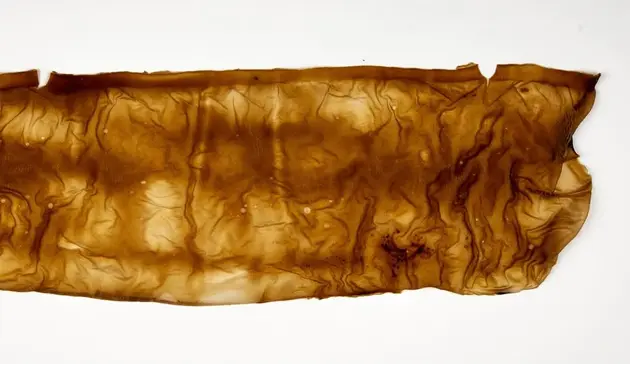
NZ: How much does control play into your process? Because with materials like this – for example, using tea and other natural dyes and colourings, you can’t control the hue, the outcome -- you often have to surrender a certain amount of control.
IIt’s really hard! The minute you start trying to manipulate [the biomaterial] and control it to achieve a specific outcome, it falls apart.
Coming from fashion, my brain was trained to work very precisely. Everything is measured and adjusted down to the millimetre. When I started working with biomaterials I initially tried to approach them with the same mindset. But the material doesn’t allow that kind of control.
So it became more of a negotiation. There are certain things I can control. For example, when I frame works under glass it helps preserve them for longer. But even then you can see that the material behaves slightly differently under the glass. Over time I actually started appreciating the fact that I couldn’t fully control it. It became something I respected about the material.
The relationship started to feel almost symbiotic: I can influence certain things, and the more I work with it the more I learn small ways to guide the outcome. But at the same time I’m not a chemist, right? This is essentially a scientific process, and I’m experimenting in my kitchen with a small digital scale from Checkers. Even when I measure everything carefully there are still variations. Sometimes only about sixty percent of the sheets I pour out become usable pieces.
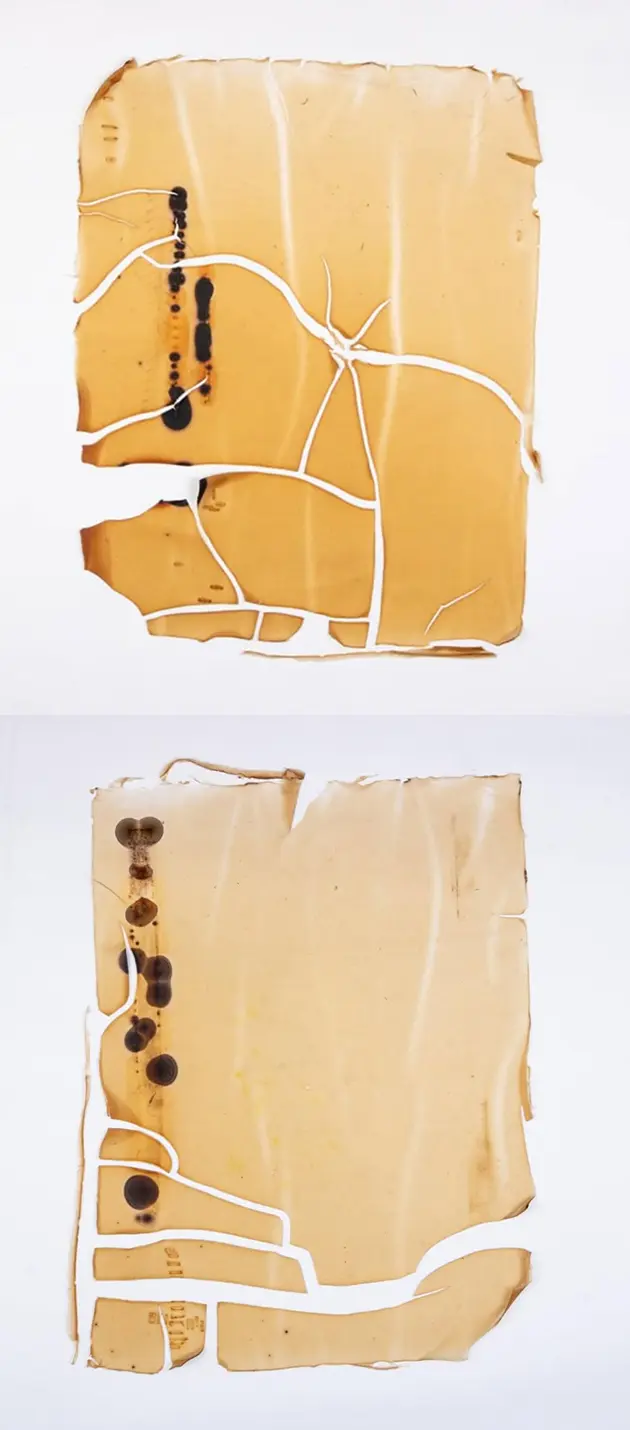
And even when I intervene — for example placing rusted objects onto the material while it dries so that the rust bleeds into it — I still don’t know exactly what the final pattern will look like.
Sometimes that makes me feel strange about the finished pieces. If something turns out really beautiful, I almost feel like I didn’t do enough to deserve it. It can feel like luck — like the material created something beautiful on its own.
But at the same time I’ve started thinking of the material almost like a collaborator. It has its own behaviour, and we’re working together.
At some point in the conversation we started talking about artists like Damien Hirst — the shark in formaldehyde and those kinds of works.
Namrata to Alexa: But I think the difference is that your work still needs your “Alexa hands” to alchemise. It needs your intervention in order to exist.
Alexa to Megan and Namrata: Maybe. I also think the art is often in the process itself. The finished object is what people see, but the experimentation and the negotiation with the material is where most of the work actually happens. Coming from fashion, I was used to thinking of the final object as the success or failure of the project. But with this work the process itself becomes part of the artwork. I’m still learning how to sit with that. I don’t think I’m completely comfortable with the lack of control yet. I’ve learned how to build a relationship with it, but I still feel like I’m trying to find a middle ground. I don’t necessarily want my entire practice to be based on biomaterial. There are things to take from it, and I’m definitely not finished with it — I’m not packing up my ingredients or anything — but I’m still learning about it. There are thousands of variations of biomaterials beyond the kind I’m making. I’m definitely not an expert.
Namrata to Alexa: Alexa the perpetual student.
Alexa to Namrata and Megan: Well, I think that’s how my life’s kind of like.
Namrata to Alexa: It’s not a bad thing.
Megan to Alexa: No, I think it’s a really good thing.
NZ: The materials themselves seem to have a sense of “in-flux”, almost like they’re in transition. Is that instability built intentionally into the work, or is it simply part of the negotiation with the material?
I think it’s both. I’m not sure if this will answer it properly, but ask me if I drift.
I originally started working with biomaterials because I’ve always had a kind of obsession with skin. I’ve always wanted to replicate skin in some way. That was the focus of my final fashion project as well. Biomaterial felt like an entry point into that because it has this specific abject quality — this “what is this?” sensation — that I hadn’t encountered in other materials.
But at the same time, conceptually, I was reading and writing about expectancy and desire. I reference theorists who describe desire as an endless machine — something you can never fully satisfy. It’s never about arriving somewhere; it’s about constantly moving toward something.
I was working with those ideas alongside the material process, and I was initially worried that they wouldn’t connect. But they ended up relating very naturally. I never fully know what the material is going to become. The pieces are always slightly unfinished.
Even technically, the material responds to heat. It reforms itself. If a sheet melts in the sun, it can harden again overnight and become something different, it never really settles.
So the pieces are always in an in-between, non-committal state. They’re never completely fixed.
MR: Exactly — they exist in a liminal space.
Yes, a liminal space. Or even just a non-committal space.
Maybe I’m also drawn to that non-committal quality. I think I might have been unconsciously interested in making something that doesn’t fully commit to being one thing.
That’s probably why I feel more affection toward the pieces that are modular or exposed to air, rather than the ones I’ve framed behind glass. The framed pieces are beautiful and preserved, but they’re also closed off. They’re protected from change.
Sometimes when I frame them, I feel like I’m cutting them short. Like it’s slightly rude to the material. It sounds strange, but they’ve almost started to feel sentient to me — like collaborators.
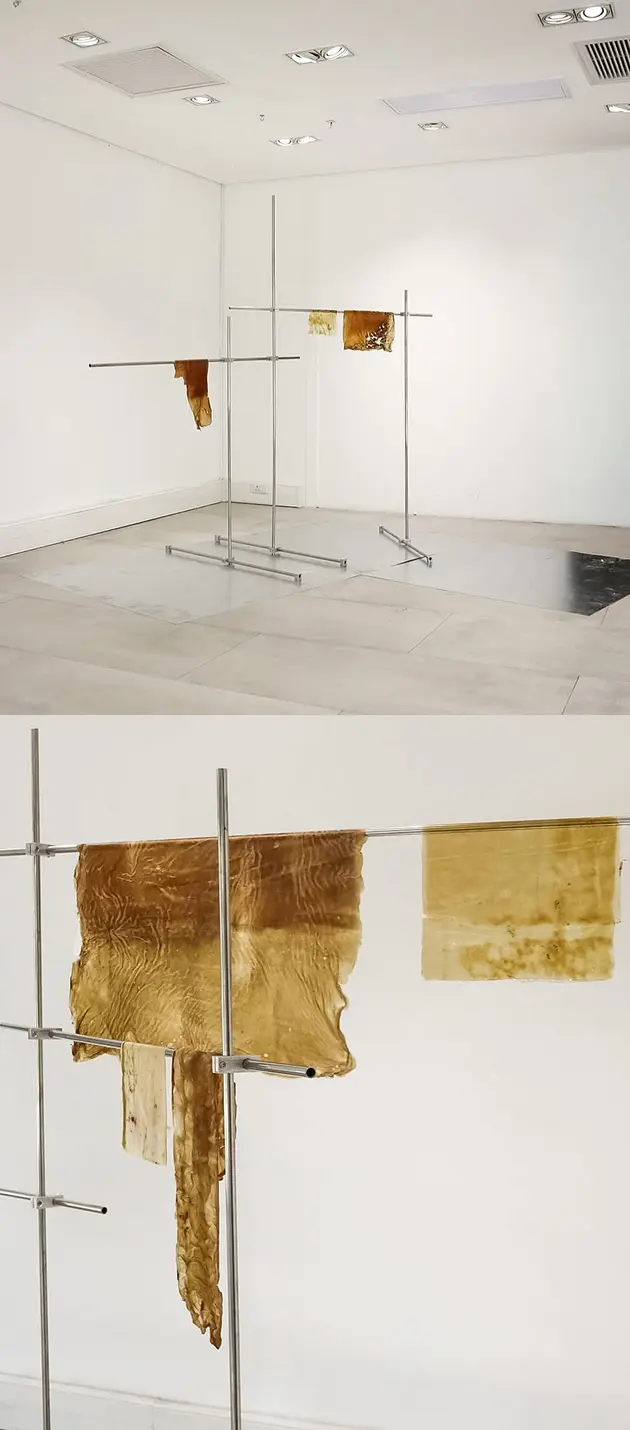
Megan to Alexa: That’s interesting because when I first saw images of the work online
I genuinely thought it looked alive.
Namrata to Alexa Like you turn off the lights and they all come to life.
Alexa to Namrata and Megan: Yes, people say that a lot.
It really does feel like it has a kind of presence or sentience. Of course it’s not literally alive, but it does have its own behaviour and lifespan. When I moved my practice from the university studio into my apartment toward the end of my degree, I actually had a bit of a breakdown because everything started melting and reacting to the new environment.
The studio had been climate-controlled, and suddenly my work was in a space with sunlight and changing temperatures. But that forced me to learn how to preserve the pieces better. Now I seal them with things like silica gel to manage moisture.
I also moved into art partly as a way to better understand what I want to do with fashion. I don’t necessarily see myself as a practising fine artist in the long term. I studied fashion for three years, and that’s still where most of my passion lies. I originally thought studying art would be a kind of supplementary experience — like a way to expand my thinking. Now that I’ve finished the degree, I’m excited to start bringing those two areas together again.
I actually still have boxes of my old fashion patterns that I haven’t looked at since 2023.
MR: How do you feel about people wanting to touch the work?
I actually like it. I’m very happy when people want to touch it. But at the same time I also like that they usually can’t.
There’s something compelling about that tension. The material looks very tactile and bodily, so people instinctively want to know what it feels like. But in a gallery setting you’re not allowed to touch the artwork, so it creates this dynamic where the object is right in front of you but you’re prevented from interacting with it fully. That tension is interesting to me.
MR: You often reference the “abject” in your work. How do you define it?
The way I approached it in my research was largely through Julia Kristeva’s definition. For me the abject refers to something that exists between categories — something that can’t easily be classified within normal boundaries. It’s something that feels both familiar and unfamiliar at the same time.
People often associate the abject with things that are grotesque or disgusting, but that’s not necessarily how I think about it. For me it’s more about that unsettling feeling when you encounter something that is recognisable but also strange. Something like skin, for example — it’s familiar, but when it’s detached from the body it becomes unsettling. So it’s really about occupying that in-between space.
NZ: Your work often touches on femininity and restriction. What kinds of restrictions are you most interested in examining?
A lot of my work has always centred on conformity. When I specialised in corsetry during fashion school, I was very interested in the historical role of the corset as a device that literally restricts the body.
More broadly, I’m interested in systems that shape people into a specific form — things like uniforms, which remove individuality and make everyone appear the same. A corset does something similar. It reshapes the body into a single ideal form and restricts movement. In my work that idea often appears as tension between something structural and something organic.
For example, some pieces involve metal elements that feel very cold and sterile interacting with the soft biomaterial. I’m interested in that contrast — structure versus body.
I think I’m generally drawn to contradictions.
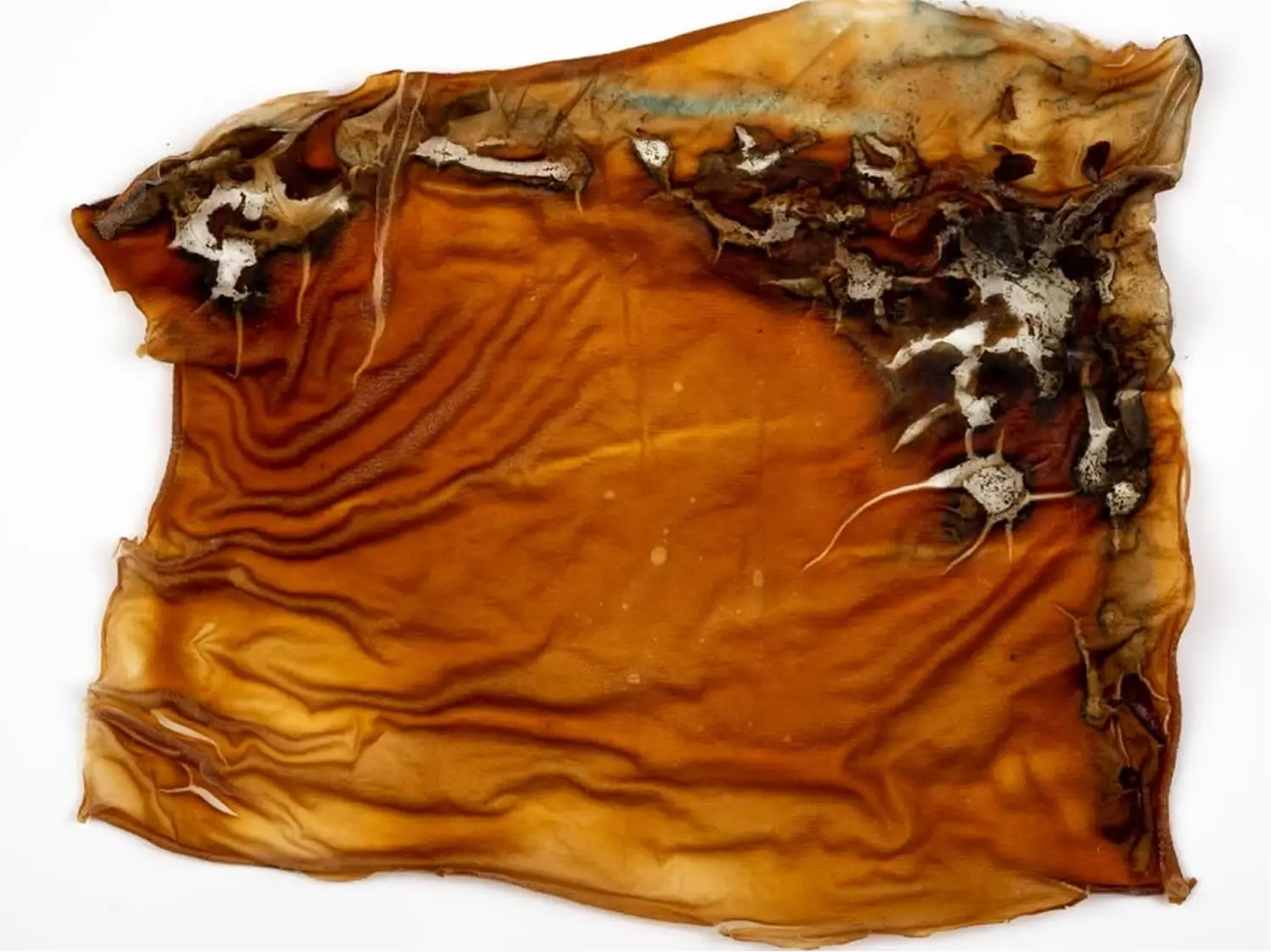
Test Piece, 7 (2025)
“I think I’m generally drawn to contradictions.”
NZ: Are you interested in expanding the work — scaling it, collaborating across disciplines, or returning to wearable forms?
That’s something I’m thinking about a lot at the moment. When I was studying art I was very conscious of not wanting to be labelled “the fashion girl.” Because of that I think I deliberately distanced myself from fashion during the degree. Now I’m interested in reconnecting those two areas again.
I don’t think I would feel fulfilled if I committed entirely to one discipline or the other. I’ve always been interested in existing somewhere in between. But I also don’t want to become known simply as “the biomaterial girl.” The whole reason I like the material is because it resists categorisation. So it would feel strange to let my practice become defined by it. At the moment I’m a little nervous about moving away from biomaterials because I feel like I’ve built a strong relationship with them.
But I’m excited to experiment and see where things go next.
NZ: Just keep being weird and figure it out.
Exactly. There’s a lot to explore, and now I finally have the space to do it.