in conversation with
Láura Viruly
Láura Viruly (b. 1997, South Africa) is a sculptoress whose work examines the visual culture of staged environments and the systems of illusion that shape them. Drawing from sites of inherently personal intrigue, her practice explores how constructed worlds operate as small, self-contained fantasies.
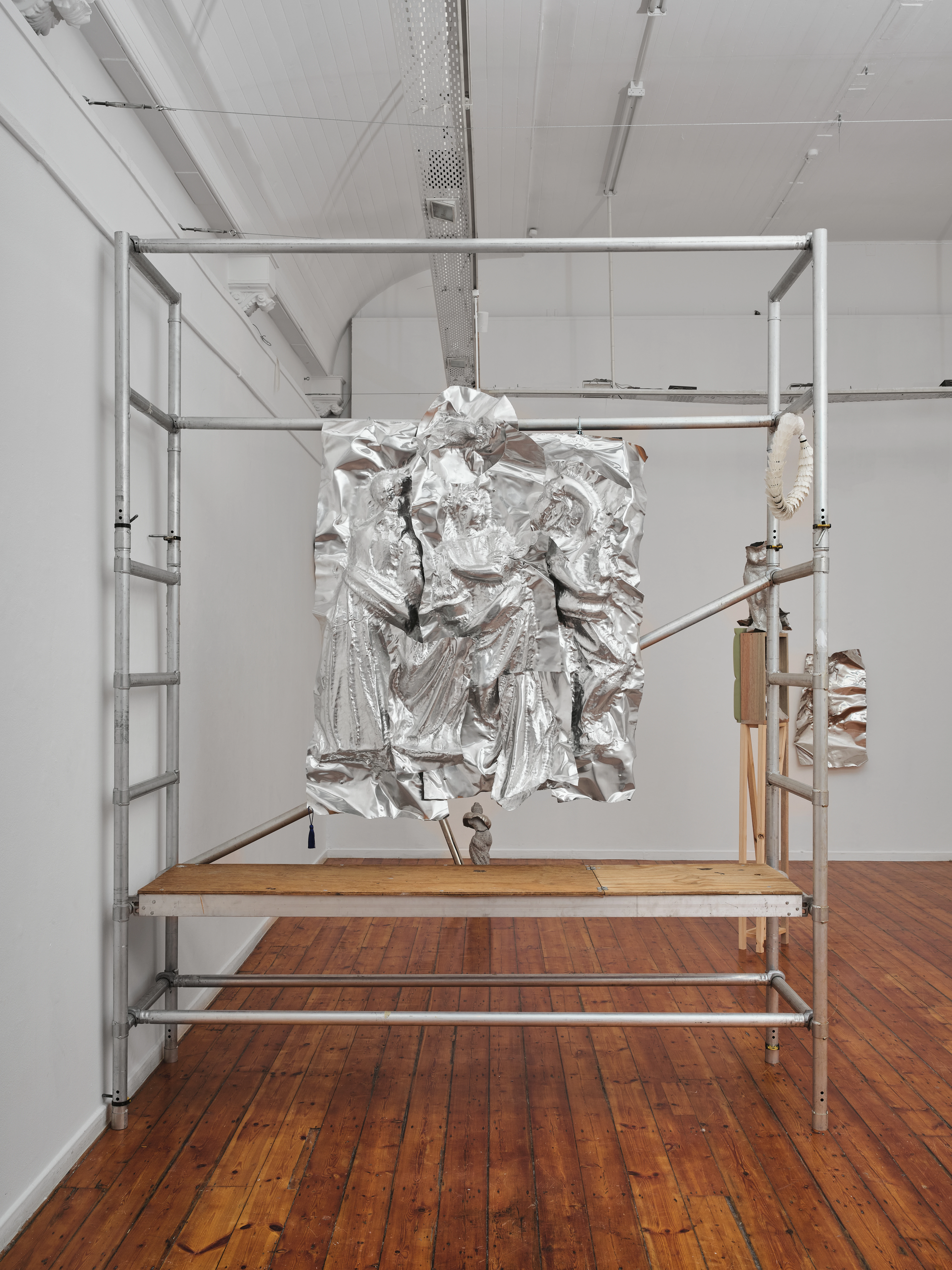
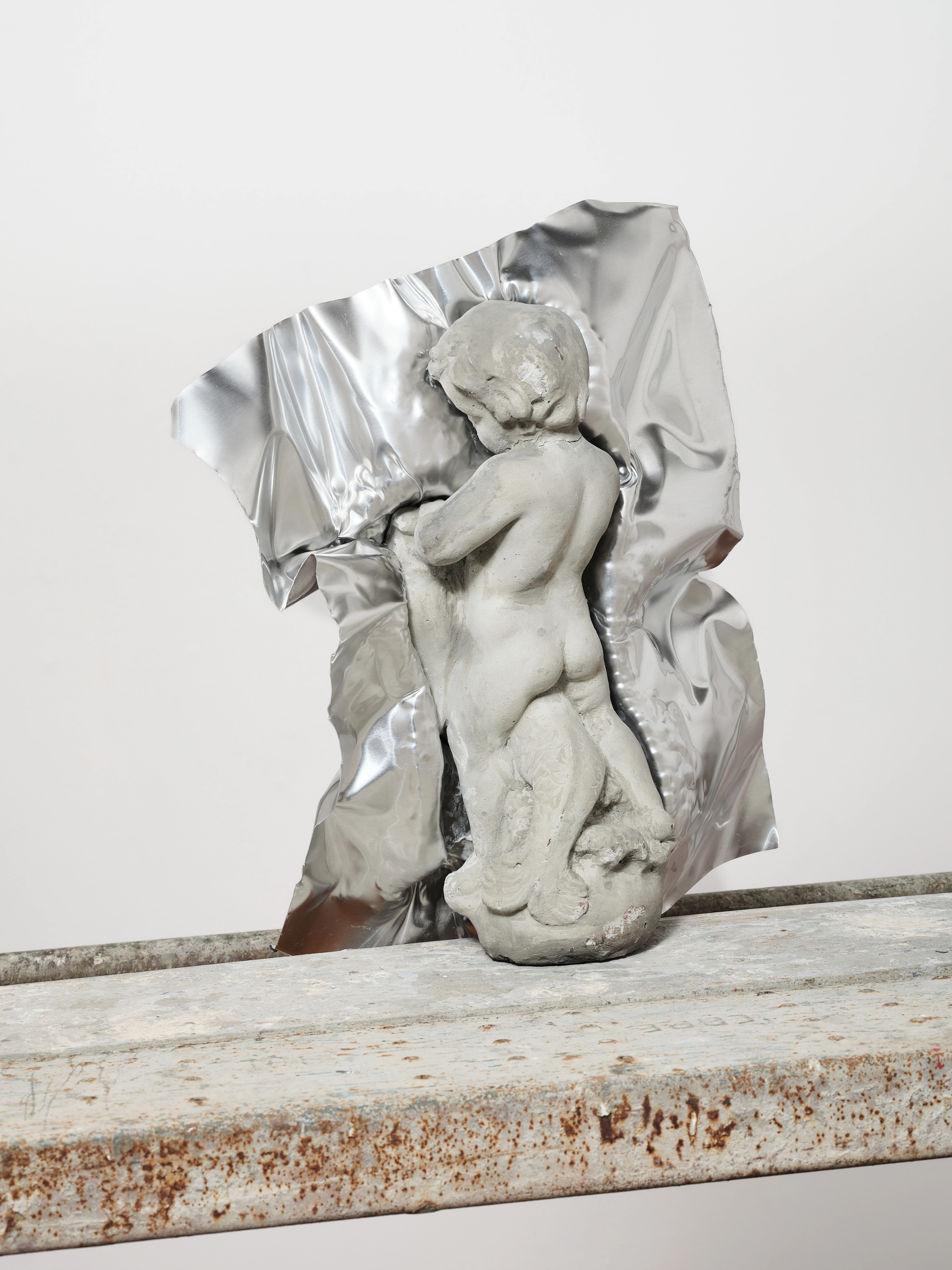
Working primarily through sculpture and installation, Viruly often uses strategies of replication as both a conceptual device and material process. In several works, she casts and forges aluminium over cement garden ornaments, producing altered replicas that sit somewhere between the ornamental and the uncanny.
Viruly constructs environments that feel both seductive and unsettling - spaces where spectacle and artificiality intersect. At Viruly's MFA grad show, Namrata had remarked that she felt a presence in the exhibition room.
In their shared apartment, Namrata and Láura moved through tête-à-tête about her MFA thesis, the ideas shaping her sculptural practice and the fate of tchotchkes.

Namrata to Láura: Thank you for making the time to chat with me today! Goodness, it is weird interviewing your roommate.
Láura to Namrata: We are in a swamp together.
Namrata to Láura: We are all in a swamp together.
NZ: Did you have a break between your honours and your masters?
I had quite a big break. I finished my BFA in 2019, then it was COVID and then I was making candles.
NZ: And then you started your MFA 2023?
2024.
NZ: Now, that's been two years of almost throwing yourself - or perhaps even becoming your craft - right? And that's now been marked by the ending: the submission, the exhibition, all the little things that tie those two years together. Where are you now and where - say, in a utopia - are you headed?
Well, I think the Masters was important because I didn’t go into it with a functional practice. I very much needed to find — I feel like I’m the kind of artist who needed a formula — and I needed the support of workshops and deadlines to find what my formula would be, what my material would be, and that kind of thing. I always wanted to treat that final show — at least for myself — as a moment of arriving. And it’s not to say I know exactly what I’m arriving into, but at least it felt like I arrived into my practice — and in many ways, myself. Not only in the metaphors of the art, but in the project itself as a Masters. Because I’m quite an inward person, I needed to use that moment of spectacle to arrive into myself as a sculptor. It needed to be a bit performative, and I think that’s what it was.
I want to make big sculptures in public environments — outward-facing metal shells on public structures with site specificity.
But I also just want to keep working in the material and see how far I can take it. Metal itself is a kind of metaphor: if you hit it in one place, another part morphs out of shape. That was my Masters. I was working in one place and something else would misalign. I’m trying to build something where I can work in multiple places at once.
NZ: What would you say is the biggest difference between your approach to your craft during your BFA versus your MFA? That five-year gap obviously consolidates some things, breaks others apart, and creates disillusionment around certain aspects. Working with wax was probably quite different to working with metal. Tell me more about how your practice changed shape.
In my fourth year, the work I made — as much as I can reflect on it with respect and kindness — was very much a product of the Michaelis lexicon. You’re in a research unit, in a cohort where you’re porous to one another. You don’t know much about the “art world” yet; you’re seeping into each other’s practices. There’s a certain tragic abandon or pathos that I’m always reflecting on. That work was a reflection of knowing that sentiment is a guiding force for me.
The animal motifs continued in a dystopian way — a crumbled, degrading quality. I’ve also always loved craft. I loved sitting with my uncles in their workshops, watching them make a hinge perfectly, make joinery perfectly, because they’d spent decades doing the same actions over and over.
Making candles allowed me to dedicate myself to one material — wax — and really know it. It also meant making a product for a product’s sake, understanding what people want in their home as a small object. It’s not a centrepiece; it’s just something they have. I’m okay appealing to something pretty someone wants in their home. It was a process of figuring out my practice. It was necessary. Becoming a businesswoman was necessary. Many young artists don’t know how to conduct themselves as business people of their own creations, and running a candle business was all of that.
By the end, I detested it because I felt like a factory. But now I’m kinder to those years. They were very necessary. I don’t think I’d be making the way I am now if I hadn’t done that. I would probably still be on a lost train trying to be an assemblage sculptor — which has its place — but I’m far too distracted. I’d keep picking up objects until the end of time.
NZ: Did wax feature in the making of your MFA body of work?
Oh my god, yes. I thought wax was going to be pivotal. I started making a carousel out of wax: two hollow horses with a slot for a candle inside them, wax curtains — the idea was that the carousel would spin and the wax horses would melt as it turned. I thought it was my pièce de résistance.
My supervisors were worried about it being a fire hazard. They asked if I could use fake candles, and I said I couldn’t.
I’m glad I didn’t make it. It might have been a gimmick in relation to the material I did know. But it was part of the process.
NZ: I remember the wax horse from your first year show - it was up there with the metal frame. One of my favourite pieces.
It’s a beautiful piece. Maybe I should recreate it with what I know now. I also had these large, brutalist wax candles that were bent over — meant to become a wax fountain. Saying it out loud, it sounds beautiful. Wax is almost too easy for me. I think that’s why I didn’t pursue it. I knew I could finish it quickly, and I wanted to pick up another craft — something more archival, sturdier.
NZ: We said that wax and metal, in a way, behave quite differently. But was there any similarity in working with the two?
Often, when casting metal, you begin in wax. In jewellery, jewellery wax becomes metal; in bronze casting, wax burns out in the kiln. Wax and metal have a relationship not because they act similarly, but because wax is often the invisible original of the metal. There’s something beautiful in that.
But in terms of how I work — forging and forming metal — they’re completely different. Wax is forgiving. It’s additive and deductive. You can mend wax. I went from a very forgiving material to an unforgiving one in terms of yield. The aluminium I work with is malleable in the spectrum of metals. It allows repetition and a nice workflow.
“Childishness will always be important to my practice - that's when world building begins. We live in a time of densification - images, objects, waste, living conditions. Everything is increasingly dense.”
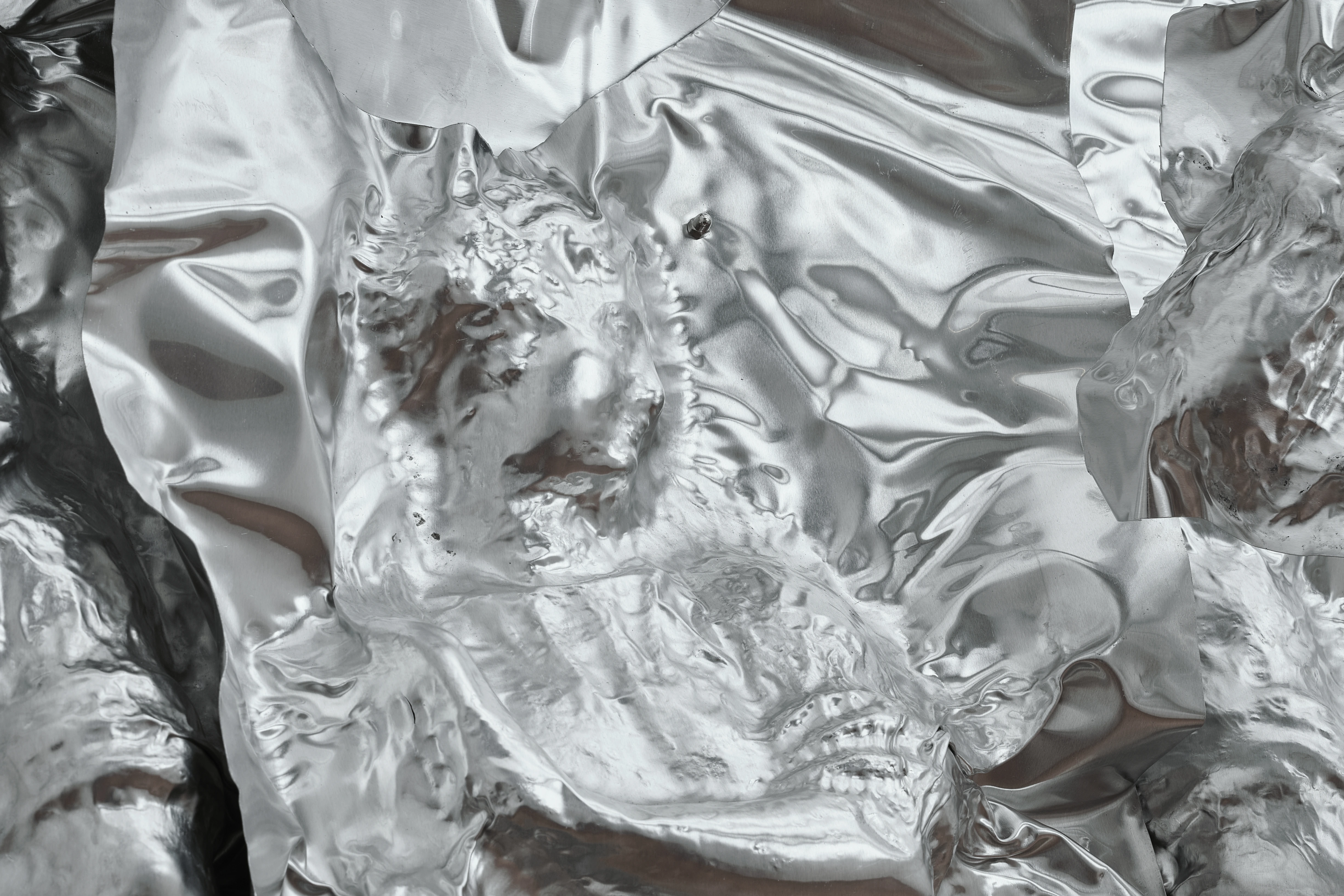
Detail of Sorelle (2025)
NZ: That's quite a profound way to put it. A lot of people are kind of scared of that part of themselves, and I think world-building is a process of self confrontation.
[My sister] Nathalie and I were having this conversation — like you mentioned, my mom, she’s such a weird, whimsical, crafty woman — and we were like, how did we end up here? We treat images with so much importance. We’re always trying to make meaning out of actions and gestures.
We found this shared memory: whenever we travelled — and I was lucky that my parents were really interested in travel and took us to interesting places — we were only allowed to buy one souvenir. One item that had to signify not just the trip, but maybe even the nation in some way.
From very young, there was this pressure to find the right little totem for the experience. Often we’d miss the one we really wanted because we thought, “there’s going to be something better.” And then we’d end up buying something we didn’t want as much, because we’d already moved on.
We both remember thinking, “I need to pick the one right object to signify this trip.” We joke that that might have been part of being cursed into becoming artists and curators.
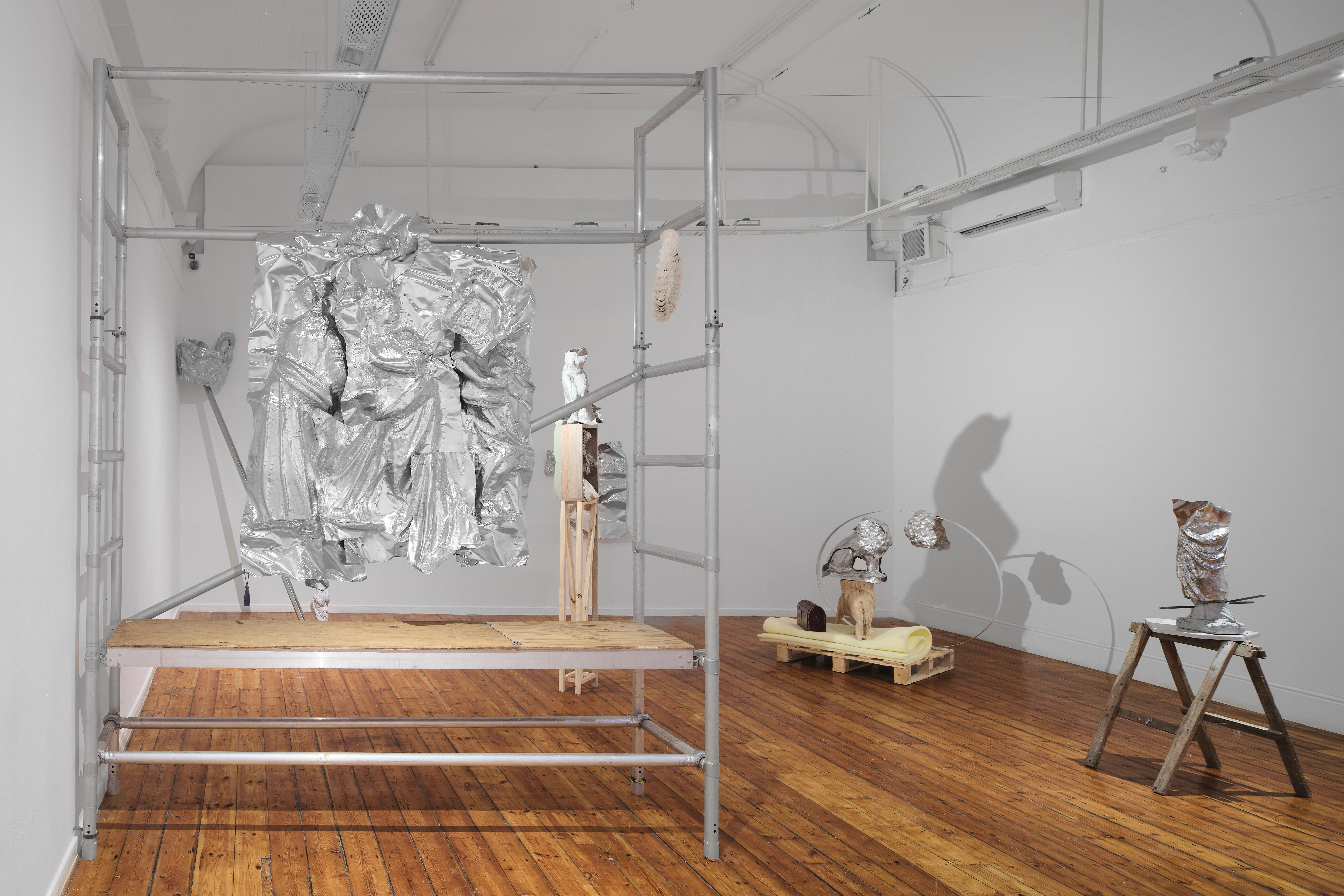
Room of Copia (2025)
“From very young, there was this pressure to find the right little totem for the experience. Often we'd miss the one we really wanted because we thought, ‘there's going to be something better.’ And then we'd end up buying something we didn't want as much, because we'd already moved on.”
NZ: Big pressure to put on a kid's shoulders. Something that came up for me in this conversation - particularly about theses - is that they're quite important artefacts. This applies to artists and makers working through institutions. A thesis almost becomes something you can survive from.
I think any maker reaches a point where they’re in a kind of purgatory, unsure where they’re headed. And then they have this thesis — this baseline — that commemorates that earlier process of becoming. I think theses deserve more gravitas. People don’t often speak about them once they move forward in their practice.
NZ: With everything we've spoken about, over the last two years, what was the most difficult part?
I lived so many lives. In my first year especially, I was such a magpie for craft. Every month I picked up something new thinking, “this is the one — the whole show will be made of this.” Stained glass, then wood, then metal. I kept trying to settle on a material and nothing felt quite right.
So really, overcoming a crisis of confidence was the hardest part of that first year.
I made my first aluminium sculpture in November 2024, and that became the strongest material thread. I practically made all of the work in one year — the first year was experimentation.
There were multiple difficult aspects. At first, I hated aluminium. But the hardest part was allowing myself permission to settle. There was a supervisor meeting that felt like the day the doors opened. I could sense they were confused by me — I was always there, but doing a hundred things, producing this strange eclectic collection that didn’t cohere.
Then one supervisor said, “Please just make aluminium sculptures. It’s going to be really nice.” I sat with that.
The hardest part was the mental hurdle of giving myself permission to commit — to know it might not be good yet, but that I would make it good. That was the difficulty. And it was necessary. I’d been waiting for that moment for a long time, so I’m glad it came.
NZ: You once said “life is a constant process of self-obliteration”. How does your material process mirror that?
I’ve always had a destructive quality in the way I make things — and in myself. Even in that tumultuous first year, I wouldn’t allow myself to finish something. I’d destroy it out of frustration when it didn’t meet my own projections.
Something serendipitous happened with cement in relation to the metaphors I was exploring. I was doing an auto-ethnographical study of my own playbook of world-building, and these concrete ornaments began to signify symbols I kept returning to — as if I’d only been prescribed a few that I couldn’t escape. Those symbols became motifs.
It created this strange tension between sacred and profane images. Symbols that feel deeply personal — central to your inner self — are also reproduced in banal ways, sitting moss-covered at the bottom of someone’s garden. There’s a cyclical feedback loop: symbols sacred to me, but rooted somewhere in pop culture. You start to realise you’re on a conveyor belt.
When you work the material — vandalising those symbols into sculpture, something supposedly more sacred than the concrete ornament — you make that metaphor tangible. You break serial objects to produce something “original” that isn’t truly original. In a way, you’re trying to restore sanctity to what is essentially a crude copy of images of images.
I’ve also always liked cement. In my first year there was a proposal for a room of large, heavy cement sculptures — very brutalist. People asked, “Aren’t you talking about play and childhood?” and I said, “No, I’m going to make big, brutal things.”
Cement is a strange material. It’s not very strong, though we assume it is. It introduces limitations. When forming metal over cement, you can only extract a few armatures — maybe four at most. And with each iteration, the central figure loses something. With the muses, the first copy had both arms. The second lost them. The third lost something else again.
It wasn’t intentional. It just happened through the process. People are drawn to those kinds of material narratives in sculpture, but it wasn’t something I sought, it just kind of happened.
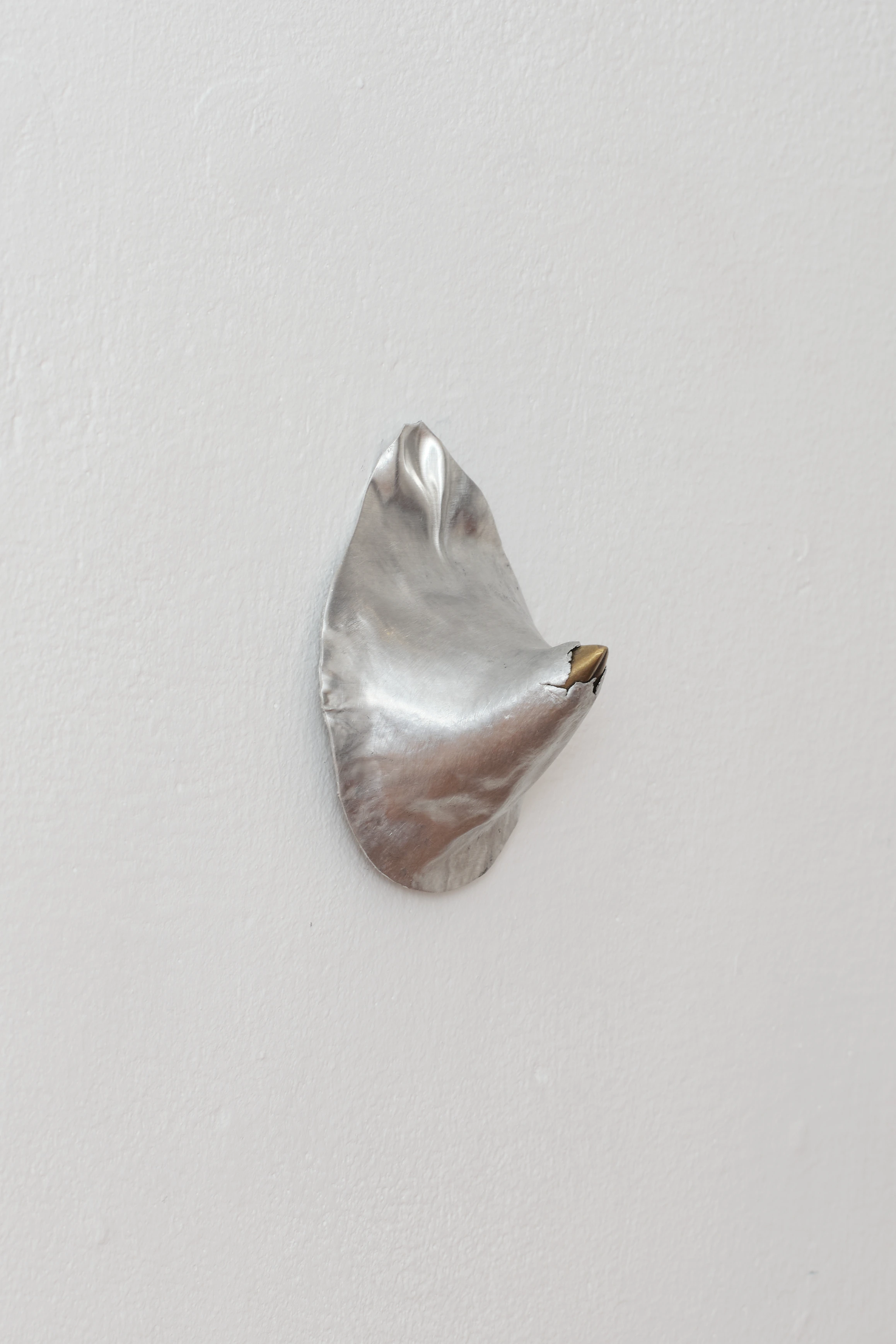
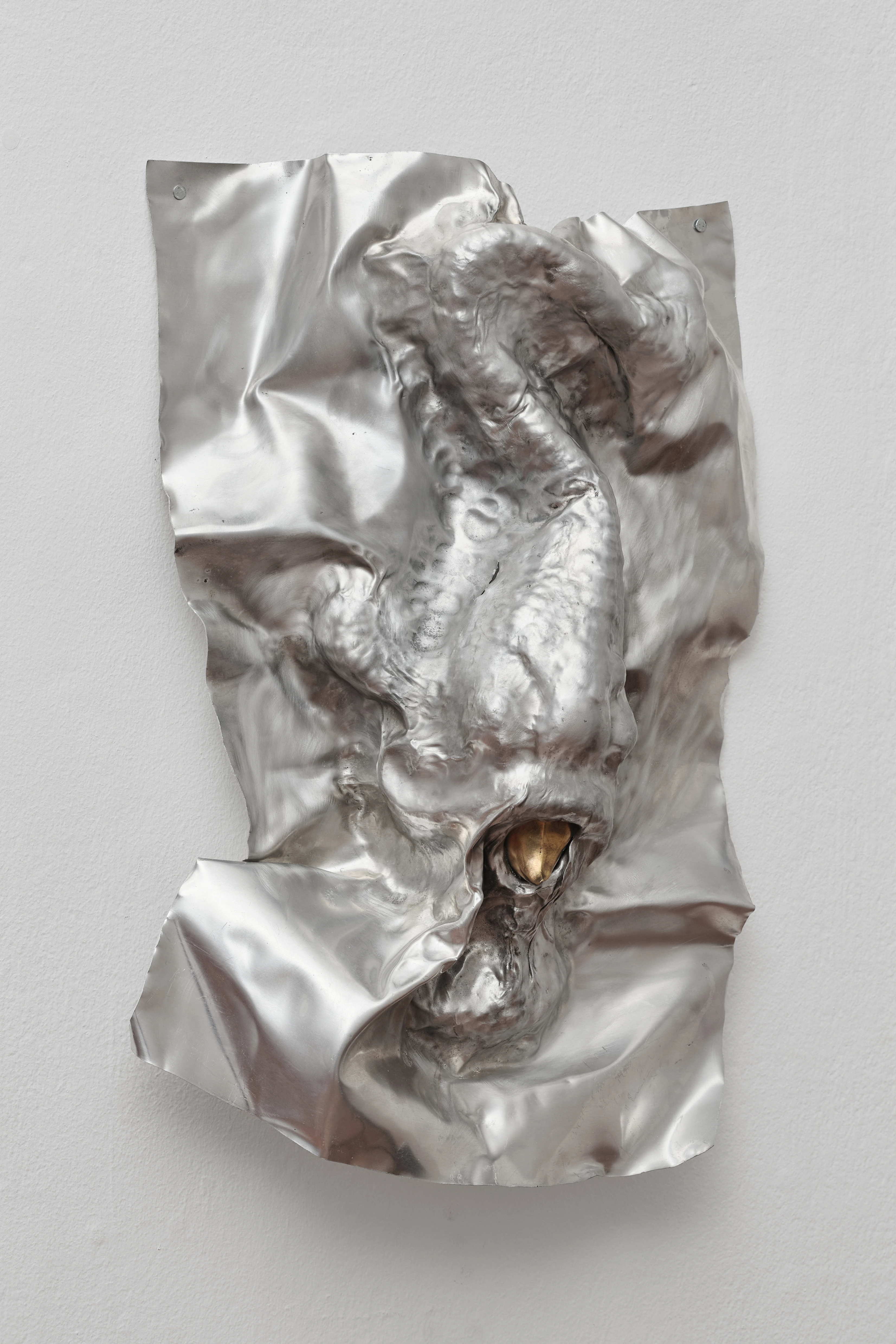
Saint's Nipple (2025)
Namrata to Láura: Also, I realised that we both braided our hair without realising it, during the course of this.
Láura to Namrata: Entangling our mind!
NZ: You’ve collected various tchotchkes throughout your MFA process — from a rocking horse to cement cherubs. If I look around, this room feels like a constellation of your practice. What’s the initial defining line? Is it a strange object you stumble across and can’t stop thinking about? Is it a motif?
I do have an obsessiveness about objects. Recently I bought something on Facebook Marketplace to work in relation to one of my sculptures, and when I saw it, I couldn’t stop thinking about it. There’s a kind of magical realism or mythological quality that I project onto certain objects, and then I have to have them.
In my thesis I write about the law of copying by contact — the idea that things, once in contact, continue to act upon each other. I’ve always thought that small objects carry traces of other worlds they’ve touched. Those worlds hold meaning, and the objects become little conduits that others can pick up.
IThat’s why souvenirs or snow globes are so compelling. They’re tiny worlds you can collect and place on your mantlepiece. They signify something, and they give you a strange godlike quality — you can create a catastrophe inside a miniature world.
The miniature — the model — is always important to a sculptor. It’s like toys. There’s something inherently childish in it. I think many people are endeared by miniature worlds — dollhouses and the like. The tchotchkes I collect feel like extensions of that. I’m making models of what’s happening in my head through them.
NZ: It ties back to the fact that to meet yourself as your kid-self — that's hard. By the time you're 25, 26, you can't do it anymore. So it's, it's incredible that you preserved it in your practice. Your parents have preserved it in their practice of building their home.
Yeah. My mind was trying to sort through all the visuals living in houses with my parents as well. They keep everything –- it's quite special.
NZ: Is there a material that you're reluctant to explore?
There are many. I’m a hypochondriac — I assume everything will poison me. Stained glass was already tricky. I probably won’t work much with glass because I dislike the soldering process. I don’t think I’ll work in ceramics either. I’ve used clay in other ways, but I’ve never taken to ceramics. It doesn’t feel right, which is strange because it’s considered primordial. I don’t work in that very incarnational way.
NZ: Pivoting slightly — we talk about this often, and it’s a major part of discourse in your industry. We live in a world where the choice of consumption feels taken from us. We’re constantly consuming one another. If you could choose what viewers leave your work with, what would it be?
I was always thinking about spectacle — casinos, spaces that manipulate scale. They make you feel godlike and then small; you submit yourself to a big icon or figure. That dynamic was important. But I hope people leave with a sense of invitation. In that installation, everyone was invited into the world I built over two years. It was a personal and sentimental show. If you paid attention, you could sense who I am. I hope people spend more time using their bodies as conduits for their inner worlds — making spaces where others can see them, even if those spaces are small. Don’t migrate to fantasy worlds built for you. Try to build your own.
I heard a quote recently that was like, “we're all just children fiddling on the ferris wheel like the big motion of the earth thinking we're gods, whereas really you’re kind of like dislodging this, like, this beautiful thing”. For me, that’s about being more sensitive to the symbols you digest, how you reinterpret them, how you replicate them in who you are.
There needs to be an urgent call about the images we’re constantly bombarded with.
Which ones do you subscribe to?
Why do you internalise them?
And once you do, how do you make them yours?
How do you make them human, connect them to who you once were, rather than consuming them into who you think you should be?
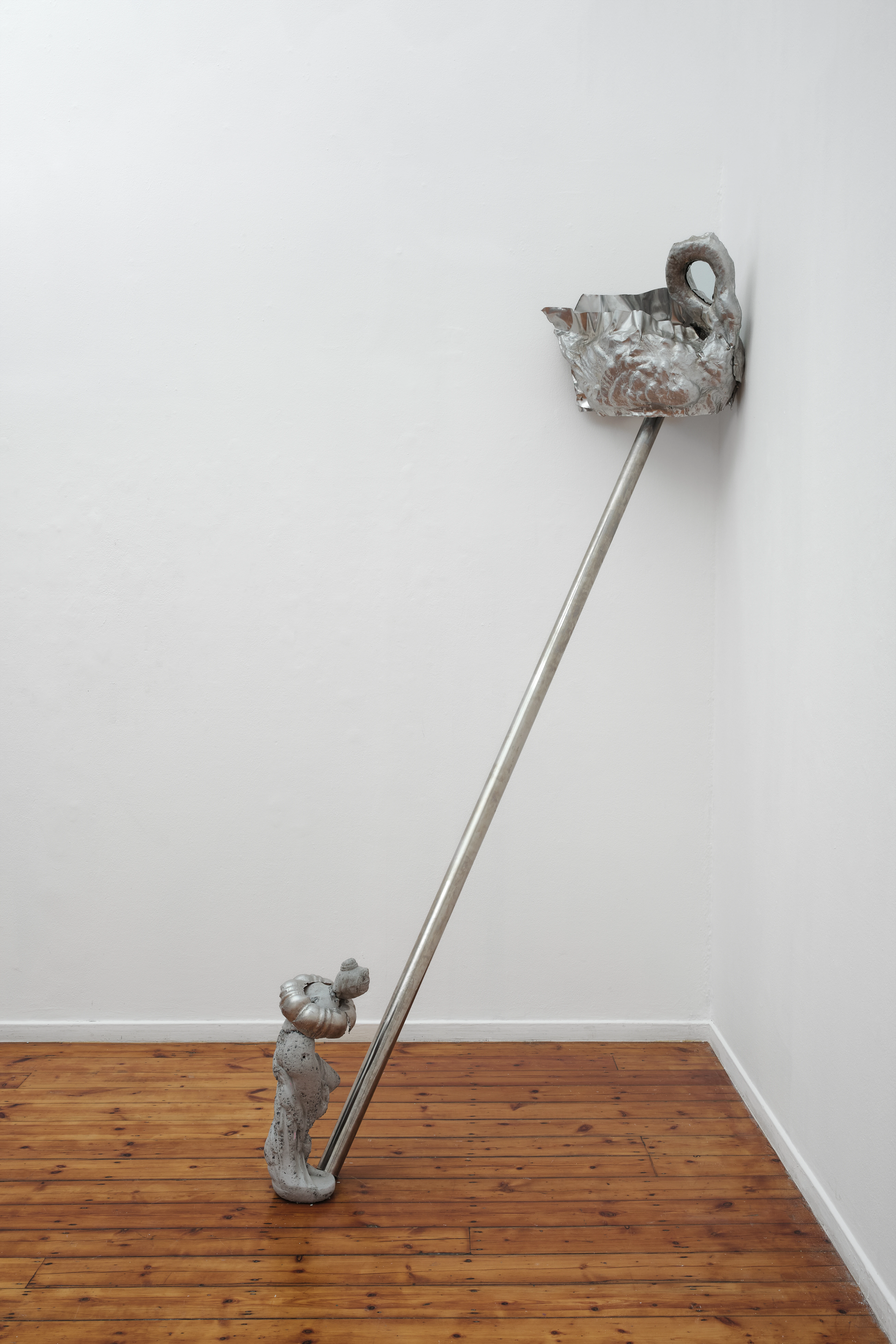
Láura to herself: Are there any other materials?
Láura answers her own question: No… my hypochondria will guide me.
Namrata to Láura: Clay is primordial soup.
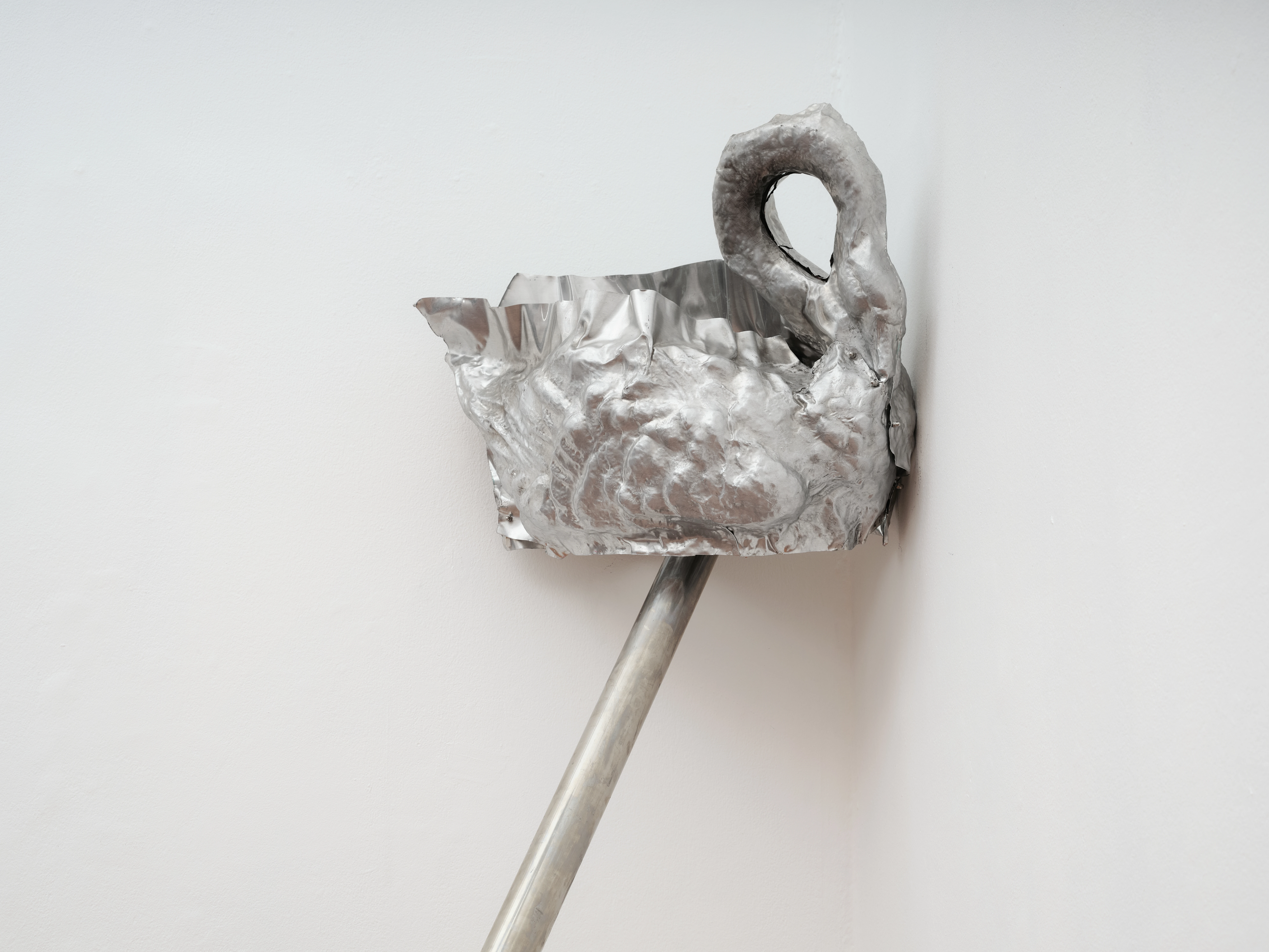
Detail of Voltaire and Spinoza (2025)
“There needs to be an urgent call about the images we’re constantly bombarded with. Which ones do you subscribe to? Why do you internalise them? And once you do, how do you make them yours? How do you make them human, connect them to who you once were, rather than consuming them into who you think you should be?”
NZ: What’s the most limiting and most liberating part of your practice?
Sometimes the most limiting thing is motivation — that disillusioned thought: “am I just making strange little things and no one cares?” I imagine many artists grapple with that. Finances can be limiting. So can the process itself — working with a jig that doesn’t quite translate what you want. I’ve started making my own forms instead of always relying on cement figures, so I’m overcoming some of those constraints.
The most liberating part came in the final months of my Masters. I felt comfortable. It felt like the material and I had reached a mutual understanding. I could see myself improving. Watching the work get better materially felt restorative. Improvement becomes addictive — unlocking each stage in the process. You feel like you could just keep going.
NZ: We speak about your mum often. She’s present in your thesis. Via Wax is named after Silvia. Many motifs in your work reflect your childhood. She’s a determined, vibrant woman with a deep affinity for nature, justice, truth. She feels like a baseline. Do you see that changing?
She always wanted us to express ourselves in as many ways as possible. I often return to her and that side of the family. The women on my Italian side were dedicated to seamstressing and sewing — generational craft.
But my mom had a rebellious streak. She’d be asked to complete something in a particular way, and she wouldn’t. She’d change the colour, alter the pattern, grow frustrated with the prescribed method and make it her own.
That inclination — existing within tradition but choosing to be a renegade — speaks to me more than the tradition itself. She’s also so physically capable. Strong hands. She did the hard work in our home. It wasn’t my dad. I always admired that. That capability, that making — it’s a big part of me.
NZ: Everything you’ve spoken about — beating, forging, destroying, remaking — feels cyclical. Would you say your work represents becoming, or commentary?
I think it does a bit of both. I mean, I would hope that it does a bit of both.
I think it works with themes of becoming. In my thesis I explore rooms — performative sites where I enacted childhood or teenagehood. I reflect on the mall, where I had my first kiss — adolescence performed within a liminal space.
“Liminal space” is a popular term, but there’s more happening in a mall than that. I’m interested in cyclical nature — becoming, then erosion, then renewal. Becoming feeds erosion, and erosion feeds newness. That cycle will always remain.