in conversation with
Lexi Hide
Lexi Hide (b. 1999, South Africa) is currently a New York-based photographic artist whose staged images move between memory and fiction, tracing the heightened emotional landscape of girlhood and adolescence. Working primarily through constructed narrative photography, Hide draws from cinema, music and her own experiences to create images that feel at once familiar and, strangely, unknowable. Her photographs are carefully orchestrated, yet retain an immediacy of something caught in passing – allowing tenderness, tragedy, adolescent mischief and humour to exist within the same frame.
These contradictions sit at the centre of Sugar for the Pill – an ongoing body of work through which Hide returns to adolescence and the unreliable nature of remembering it. Rather than faithfully trying to reconstruct the past, she creates fictional scenes provoked by memory. Nostalgia becomes both the subject and the device: questioning how memory edits, distorts, romanticises and reshapes experiences over time. Leaving photographs that occupy a space between what happened, what might have happened and what we have convinced ourselves happened.
We spoke with Hide about Sugar for the Pill and the complicated act of returning to girlhood through the lens, alongside a period of transition within her life and practice. Having moved from Cape Town to New York, our conversation considered what it means to make work about memory while simultaneously entering somewhere entirely new.

MR: You have recently moved to New York to begin your MFA at Parsons, after developing much of Sugar for the Pill in Cape Town. I can only imagine stepping into a new city and a new academic environment inevitably shifts the way you look at your own practice. So, how has the move been, both personally and creatively? Has anything surprised you about making work in a different physical context?
When I first moved to New York almost three years ago, for a long time I wasn't taking any pictures I liked. In Cape Town I have friends and friends of friends who might know a place, have a room, or a prop, or be in the photo. I have a catalogue of friends and locations from the last decade. I didn't have any friends to be in the photos. New York is a city of ten million rooms, and I felt like I'd only been in 100 of them. I started renting taxidermied animals to fill in for my friends. Working alone and only relying on a dead animal is kind of nice, it takes away some variables.
It's difficult because in South Africa I made my photos completely geographically contextless. You can't tell where they are. Some were taken in England too, but there are no defining landmarks. I'd never include something classically South African - Lion's Head, Table Mountain, anything obvious about location. I did that on purpose, to remove the photographs from the context of South Africa.
Coming to New York, I still want the geographical contextlessness - it puts the photos in a new imaginary world. But New York is a photo desert. I feel like if you showed someone a zoomed in photo of a pavement in New York it would be recogniseable. It's been photographed to death in movies. Every time I tell someone who is not a photographer I have come to New York for my photography they say "thats the best place in the world for photography", almost every photographer in New York I know thinks it's the worst.
MR: Has your relationship to that body of work changed?
I tried to view Sugar for the Pill as finished for a while, or at least I thought it had to be. My life is different now and I am a little older, in a new city and with different friends. I tried to make new work for two years but gave up because all I want to do is make that work. At the beginning of this year I decided I can continue it, I don't know if it is the exact same project though. I'm currently trying to figure out how the new work and the old work combine, and if it is just a continuation of Sugar for the Pill, or if it is a new thing. I think it is hard for me to imagine it in a different form because I am so attached to it.
Sugar for the Pill, reflects on the recent past of me being a teenager and the new work, as it's defined, is the same as Sugar for the Pill, but dealing with the consequences of the actions I took when I was younger - being really reckless and doing a lot of bad stuff.
MR: When looking through the series, one thing that struck me was that the photographs never really document the past exactly as it happened, but rather they seem to recreate how memories feel - whether it be messy, selective, emotionally charged. At what point did you realise that the reconstruction of a memory was more interesting to you than documentation?
You can't document a memory if you weren't there in the moment with a camera. The way I came to use my memories as source material was accidental - some ideas form completely randomly. I'll be really into glow sticks one week, or glow-in-the-dark stars, and use that as a bouncing-off point.
It's really difficult to stage pictures completely from scratch - you need a cohesive narrative with all its elements, produced from imagination alone.
When I take a picture, I know exactly what it will look like. I set up a tripod, set the scene exactly as I saw it in my head, and take the same picture ten times. There might be a difference in the person's position. To do that, you have to mine your brain for ideas and build formulas.
MR: Continuing down the path of memory; when you are building these scenes, are you working from one specific memory or do several experiences begin to merge during the making of an image?
It's more about looking at scenes in my life and using them as source material. I'm not recreating one memory exactly as it happened - I'm taking a scene or idea from my life as a starting point to construct the image.
MR: Looking through your archive, there is something quite compelling about the tension in your photographs; while they are highly choreographed, they don’t feel rigid. There is always an element of accident, whether it be a gesture or facial expression. Can you say how much of it is carefully directed and how much you are willing to allow your subjects to bring into the image themselves?
The least predictable thing is the person's expression — I almost can't articulate what I want there, so I ask them to do what feels natural.
I often choose people because they have a certain look, and I know they can enact what I need - I'm using people as actors, not subjects. Most of the people in the photos I have strong relationships with, or they have strong relationships with each other. There's some representation of reality in that.
But ultimately everything is very directed, and the photos aren't about the person in them, at least in this work. They're enacting the photograph I'm making.
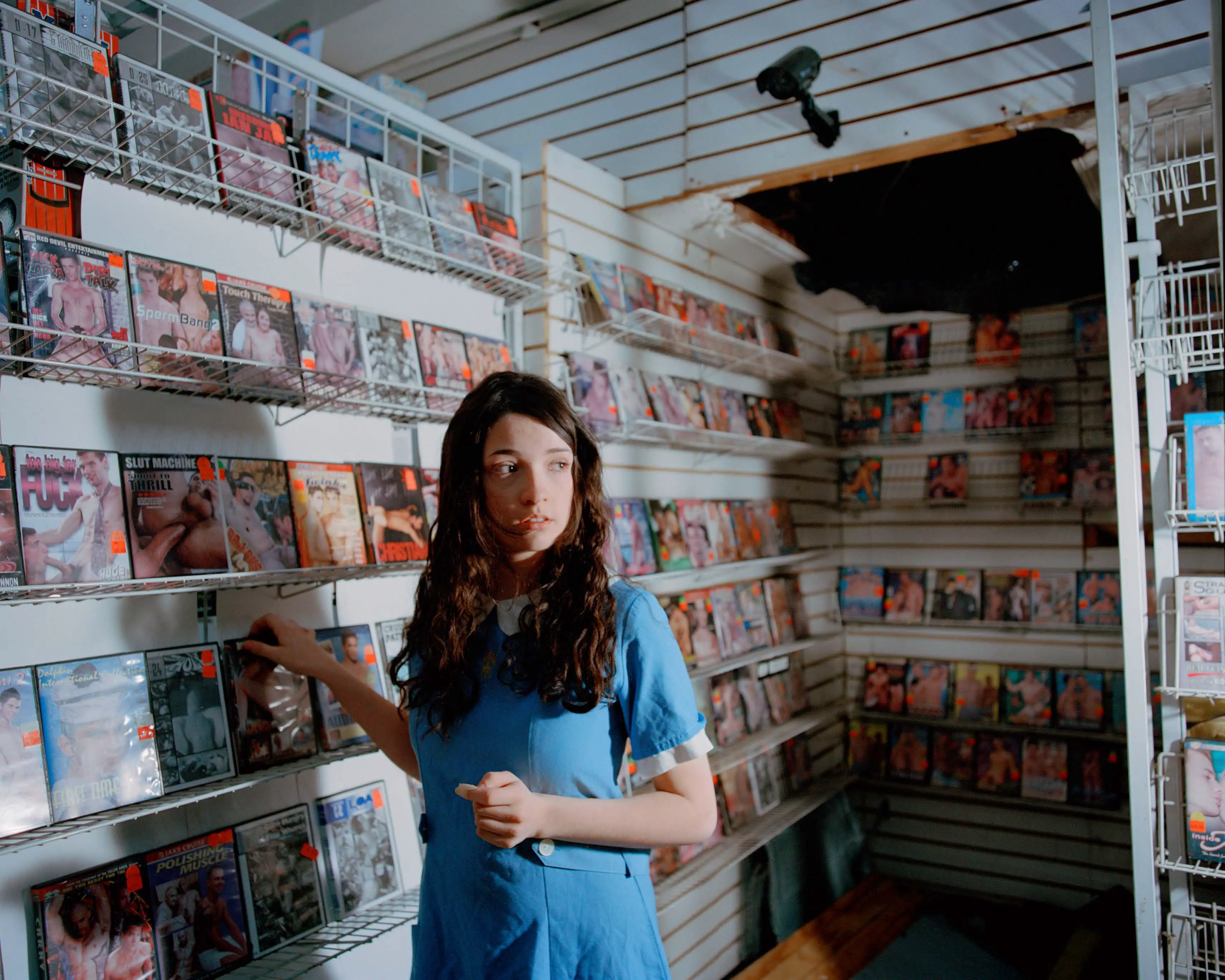
“I'm not recreating one memory exactly as it happened - I'm taking a scene or idea from my life as a starting point to construct the image.”
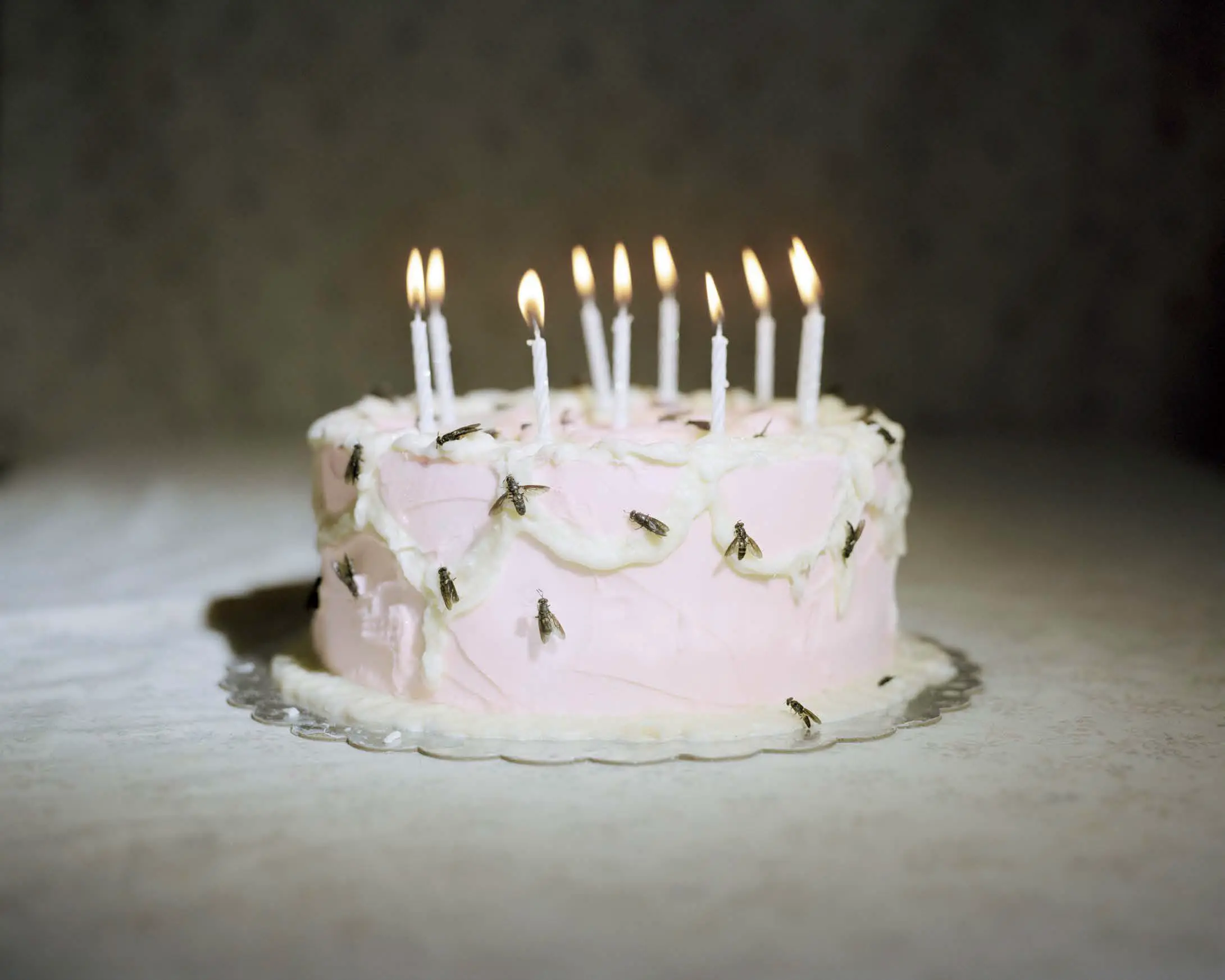
Everybody Wants to Love You, photographic print, 2023
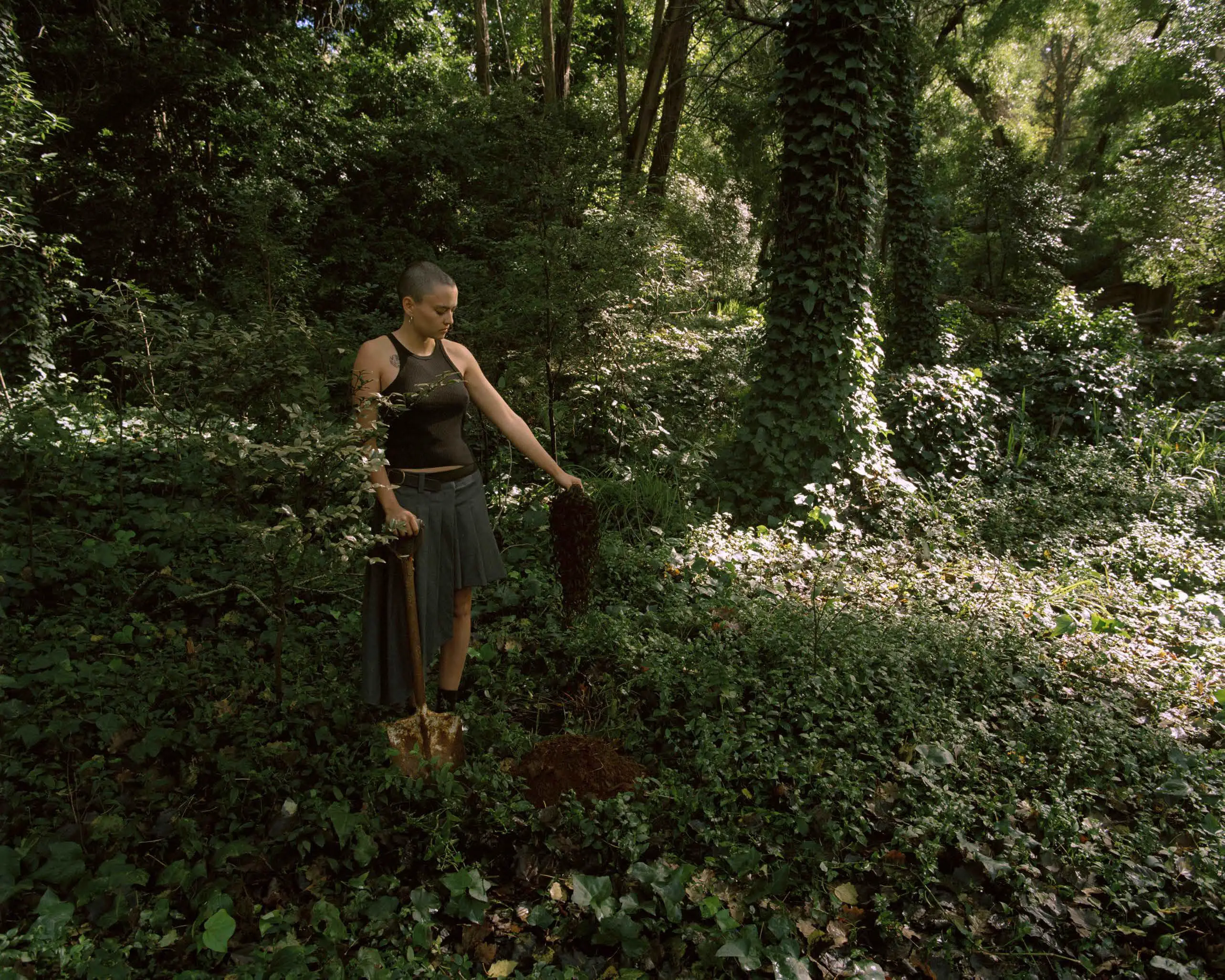
NZ: What would you say is crucial to your practice and process when it comes to developing and orchestrating the scenes in your images?
There are a few devices that I try to implement into all of the photos. I want contrasting, contradictory elements, and I want the photos to be funny and ironic, that's important to me.
Photography is an inherently nostalgic medium, it's kind of the point of it - when you look at a photo, that's the past. People unconsciously make their photos look like the past because that is what they see the photos they feel the most for are often about. I try to make them look like now, whenever that may be.
And so I’m trying to reject that, purposely, by including current technology - a Wi-Fi router, a current phone, etc. To me it's creating future nostalgia, but placing it in the now. It has already aged some of the earlier photos in a way I like. I have had to train myself out of a lot of the classic instincts of photography. I am attracted to ugly, banal or decrepid locations and think how can I make a beautiful photo here, or see beautiful locations and try to make a off-putting image there.
In ten years someone will look and say, "That's an iPhone 12 - this must have been taken around then."
NZ: What makes you choose your models? Is there a particular relationship you favour?
I use my friends because I'm comfortable with them and they're willing. It's fun on set - a hangout for me and whoever I'm photographing. I know people's limits because I'm close to them, even when the photos are a little uncomfortable to do in public. I know they'll tell me if they don't want to do something, and I can be direct with them because they understand my personality.
Since coming to New York, I don't know people as well, especially at first, and it was hard to ask people to do these things on set. They didn't have context for who I was or my work. It's difficult to direct people who don't have confidence in me, without overthinking whether they feel uncomfortable.
The main reason is knowing the person well and knowing we'll have fun. The fun element matters to me. People need to feel confident in how I'm going to represent them - otherwise the photograph won't be as good.
Namrata: How much of it do you control and how much do you let happen?
Lexi: Everything is very directed. The least predictable thing is the person's expression or position - I can't articulate that, so I let them do what feels natural and decide when it works.
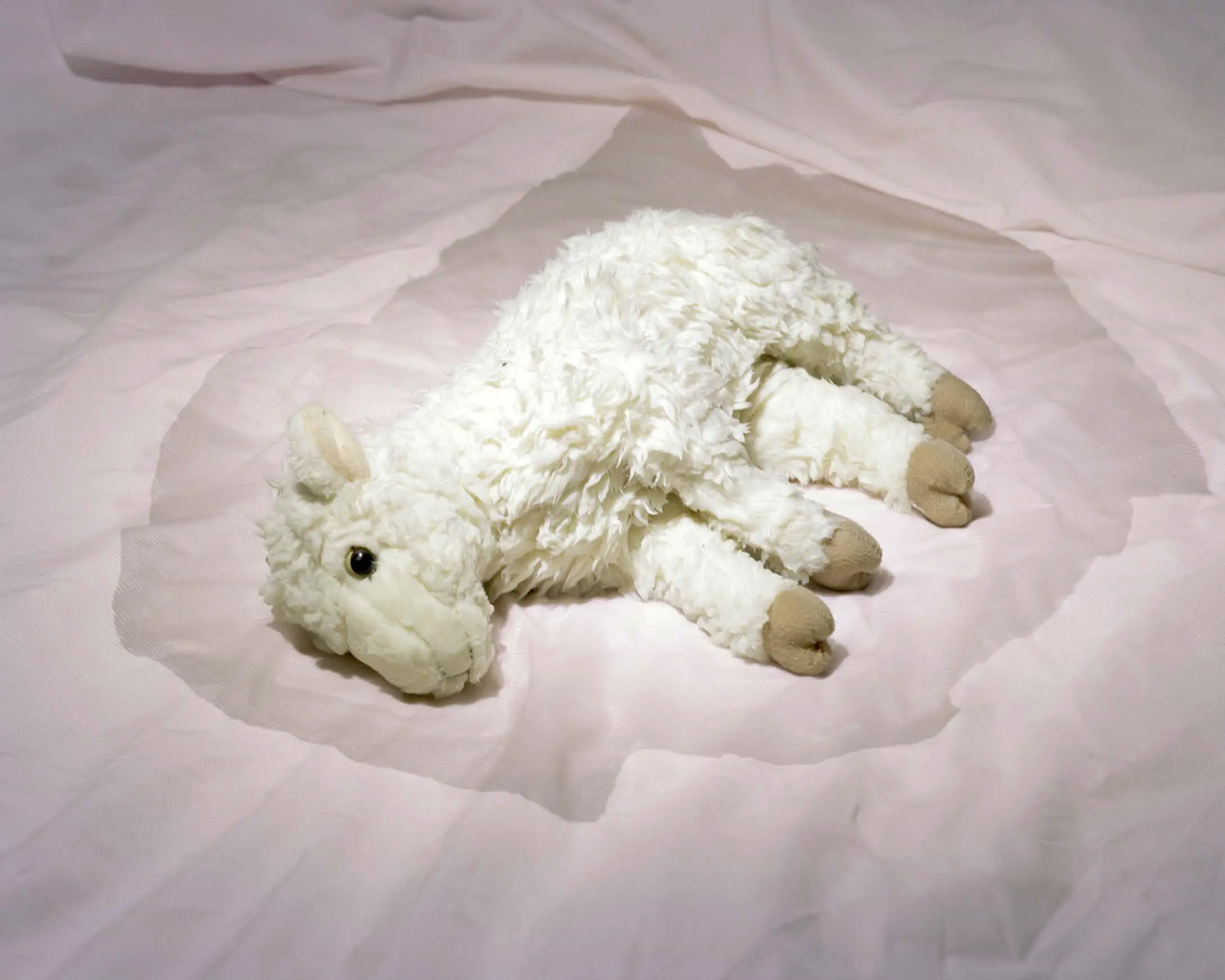
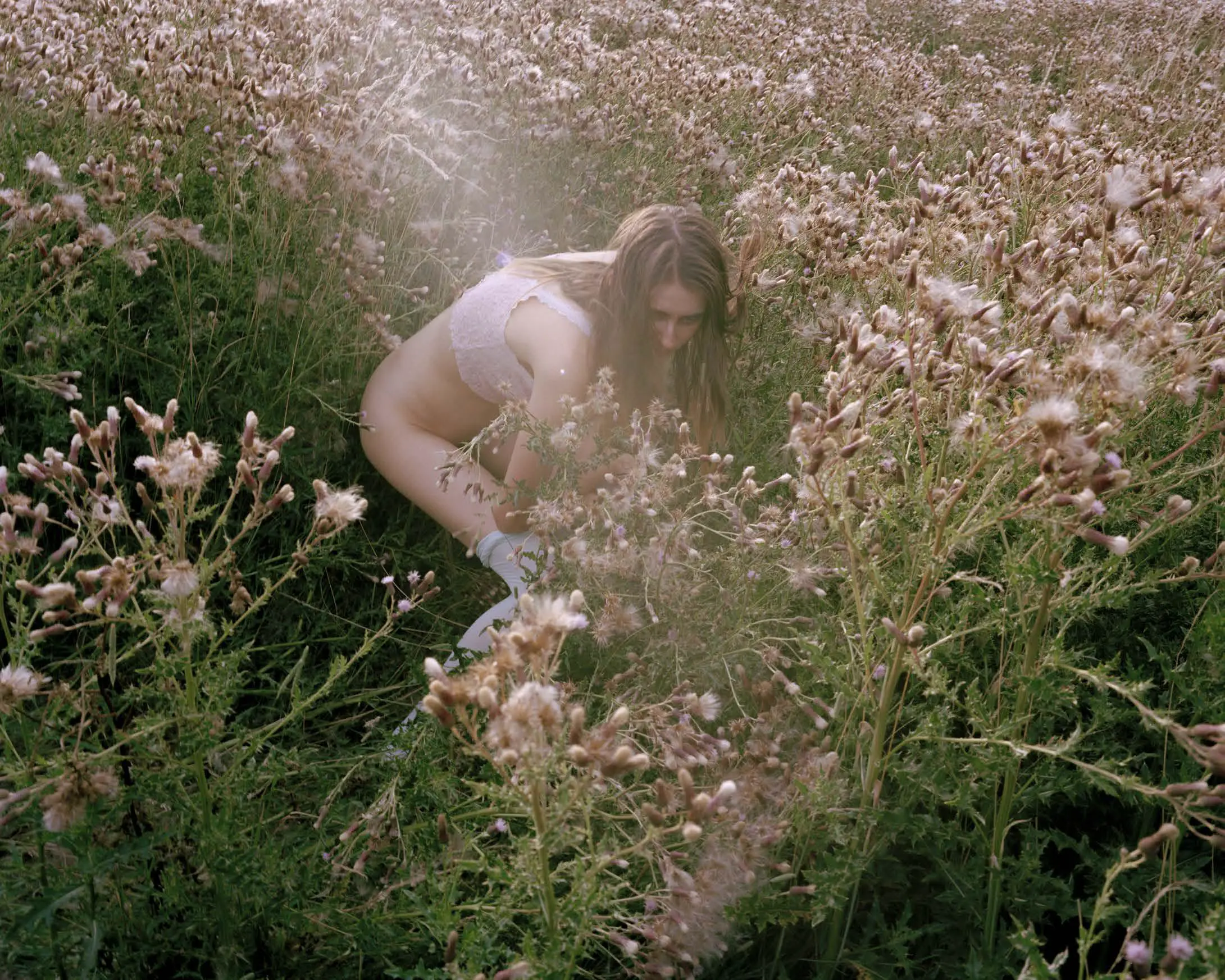
Look at You, photographic print, 2024
NZ: The project, Sugar for the Pill, is comprised of a series of tableaus, so I feel compelled to ask: if there were a playlist that aligned perfectly what would be on it? I think of the Coppola film, Palo Alto when I look at your work.
Palo Alto is a huge influence on me. I wanted my life to be like that, and sought it out as a teenager - specifically that movie. I still listen to the soundtrack all the time.
A lot of my music taste cemented when I was fifteen - indie, shoegaze, dream pop, and things that sound like that. Almost all my titles reference song titles.
NZ: Do your photographs act as an extension of yourself? If so, what of yourself - of what it means to be ‘Lexi’ - do you hope to convey through them? You say you did bad things; what in particular do you want to show? Who are you now?
The photos have my personality in them. I'm a contradictory person. If someone tells me to do something, I'll do the opposite. One new photo references that directly - the school uniform in the sex shop is from an anglican all girls school I went to for nine years.
I brought that uniform all the way to New York because I knew about the location - an abandoned sex shop.
I was always antagonising the school. People were scared of me. My current best friend was in the same class the whole time - she was terrified of me, then we became friends after high school. I got asked to leave in Grade Six, and asked to leave again six months later from another school.
My time at the all girls school was years of being disruptive, doing everything they didn't want, because I hated being told what to do. I still can't stand being told what to do. My friends know that if they want me to do something, they'll tell me the opposite.
There's also humour, I think humour is the quality I am most attracted to.
NZ: Who would you say you are compared to the version of yourself that you portray? Who is Lexi right now?
The essence of my personality was cemented early. That core has stayed the same. The photos reference a time I was out of control. Now I'm paranoid about losing control of myself. The photos are highly controlled by me, there is no spontentity, maybe to a fault.
MR: How do you see your practice evolving?
I think I want to maybe make less serious work, play around with different ways of using photography that are not very staged pictures. I'm figuring out how to think in a different way, I want to make more Polaroid works, videos, etc. I have finished my masters now, and so without academic pressure and time constraints I can be more free to make work that I take less seriously, and is not necessarily for anyone to see. In November, I have a solo show in upstate New York of my project Inside Joke, which I am making pictures for now. That looks like me running around New York with a taxidermied skunk. It is nice that doing this kind of ridiculous and fun thing is considered me working.
I am also focusing on post-production, figuring out how to formulate putting all the work together.
“My friends know that if they want me to do something, they'll tell me the opposite.”
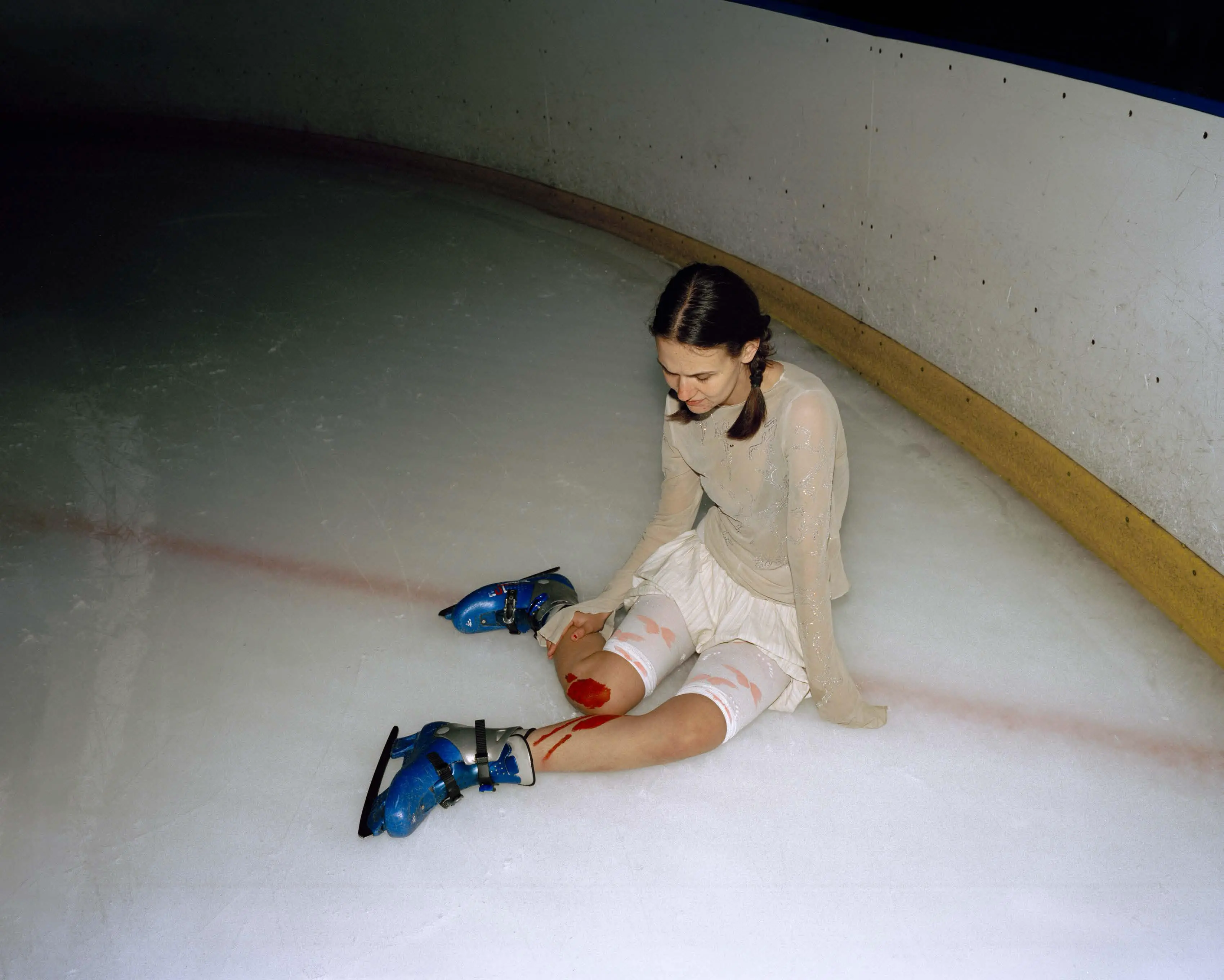
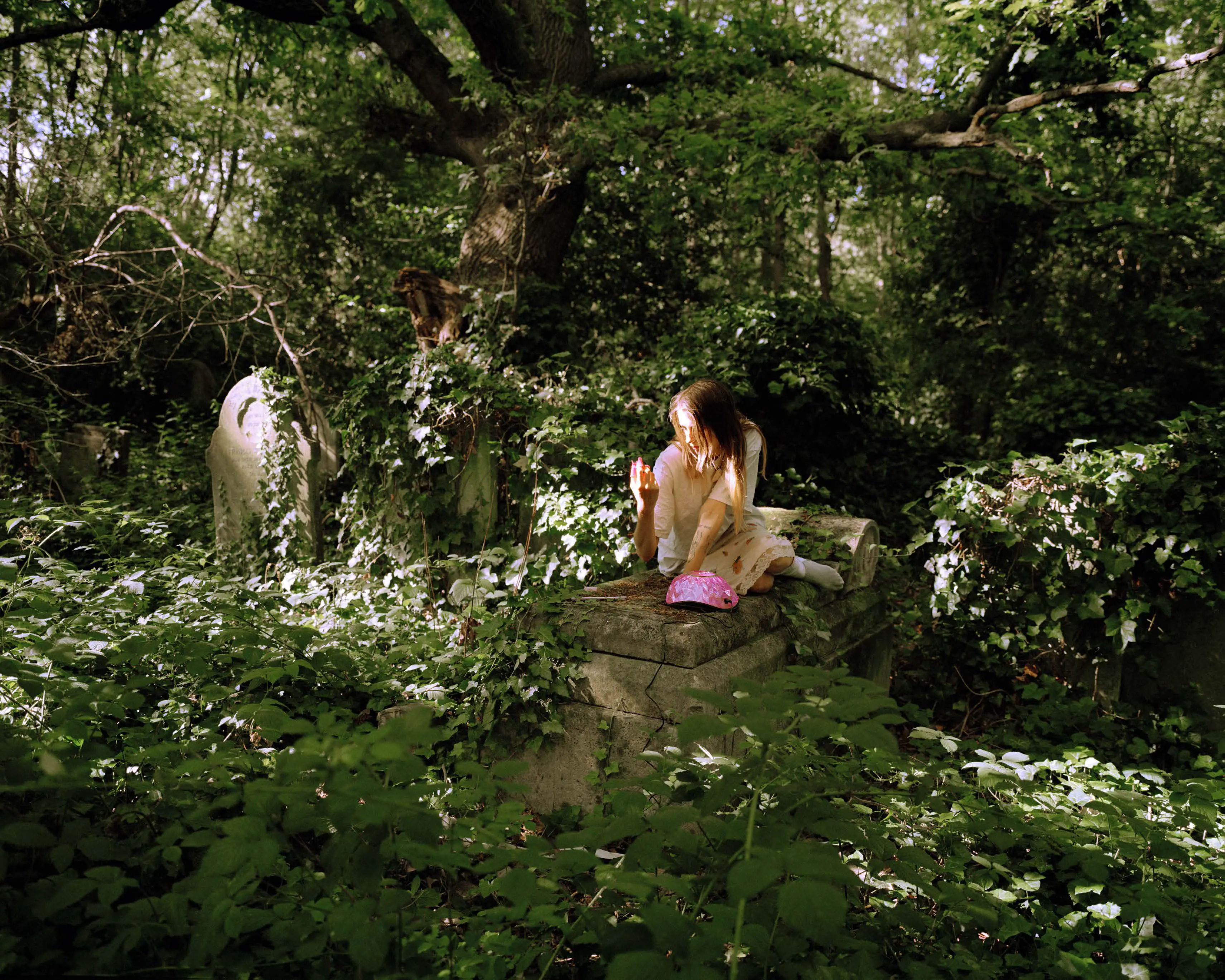
I Know the End, photographic print, 2024
A note from Lexi: I chose the songs based on what music I was listening to at the time that I am referencing in Sugar for the Pill, and still listen to now. It’s a soundtrack to my movie of stills.